



Getting Pag-IBIG deductions right before the year starts
Every Philippine employer runs the same payroll math each month: SSS, PhilHealth, withholding tax, and Pag-IBIG. Pag-IBIG often gets treated as an afterthought because the numbers are smaller, but getting it wrong still means correcting employee records, adjusting remittances, and answering questions from staff who notice a discrepancy in their payslip.
Pag-IBIG contributions matter because they are not optional. Republic Act No. 9679, the Home Development Mutual Fund Law of 2009, made Pag-IBIG a mandatory savings and housing finance program for employees, with both employer and employee required to contribute. Those contributions build each member’s Total Accumulated Value, which earns dividends and later funds housing loans and short-term credit programs.
For HR and payroll teams heading into 2026, the practical concern is simpler: what rates and salary brackets apply right now, and how do you compute them correctly. This guide lays out the current contribution structure, walks through the computation step by step, and covers remittance practices worth double-checking before you finalize your 2026 payroll setup.
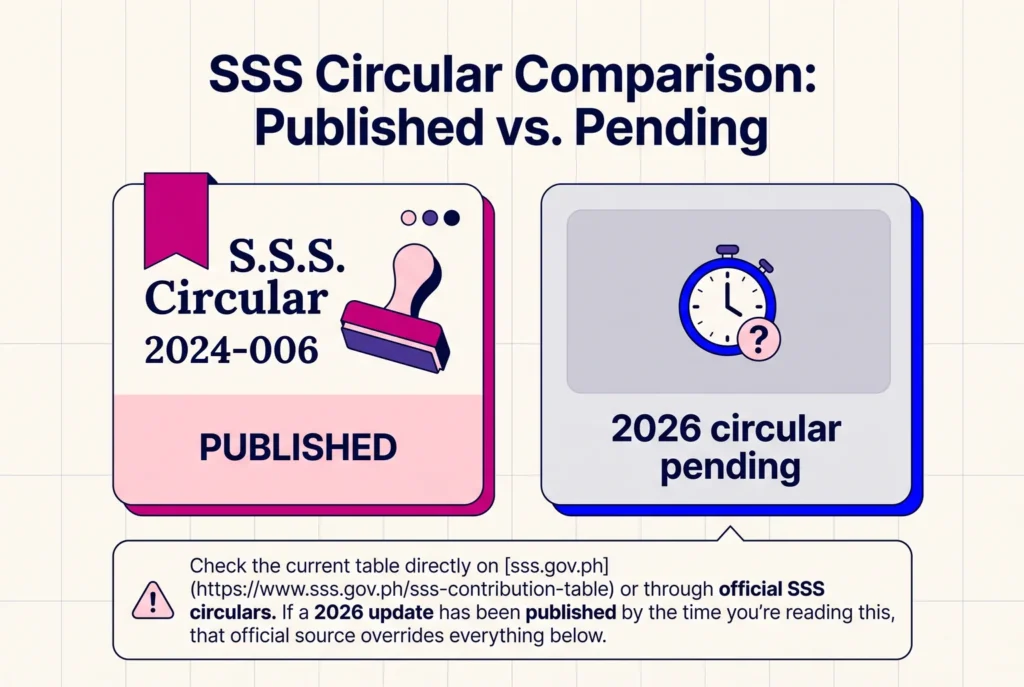
No new circular for 2026, at least not yet
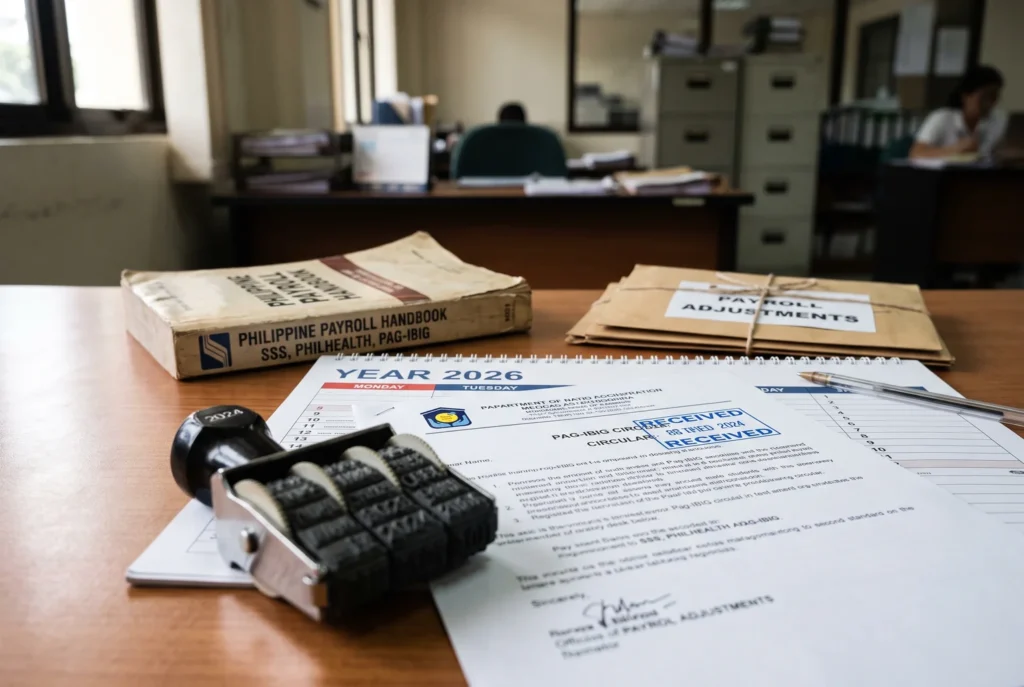
As of this writing, Pag-IBIG Fund has not issued a contribution circular specifically dated or labeled for 2026. Payroll compliance guides and HR handbooks covering the 2026 rate year consistently point back to the same governing document: HDMF Circular No. 460, issued on 15 January 2024 and effective February 2024.
Circular No. 460 is what raised the Maximum Fund Salary (MFS), the figure used to compute contributions, from ₱5,000 to ₱10,000. That change pushed the maximum mandatory monthly contribution to ₱400 total, split between ₱200 from the employee and ₱200 from the employer. Nothing found in Pag-IBIG’s published circulars or in secondary payroll references indicates that this structure has been superseded for 2026. A separate issuance, Circular No. 487, exists but concerns the MP2 voluntary savings program, not mandatory contribution rates, so it does not change the numbers HR teams use for standard payroll deductions.
In practical terms, this means the rates and brackets your payroll system used in 2025 should still apply in 2026, unless Pag-IBIG Fund publishes something new. Employers should not treat any unverified figures circulating online as confirmed 2026 changes. Before finalizing payroll setup, check the official circular list on pagibigfund.gov.ph directly, since that is the only place a genuine update would be posted first.
Current Pag-IBIG contribution rates by fund salary bracket
Based on HDMF Circular No. 460, here is the contribution structure payroll teams should use for 2026 unless Pag-IBIG Fund issues a new circular.
| Monthly Fund Salary (MFS) | Employee Share | Employer Share | Total Contribution |
|---|---|---|---|
| ₱1,500 and below | 1% | 2% | 3% of fund salary |
| Over ₱1,500 up to ₱10,000 (cap) | 2% | 2% | 4% of fund salary |
The fund salary is capped at ₱10,000 regardless of actual gross pay. Anyone earning ₱10,000 or more still contributes on a ₱10,000 base, which caps the maximum monthly contribution at ₱200 from the employee and ₱200 from the employer, for a combined ₱400.
A few reference points from payroll practitioners help illustrate the brackets in practice: someone with a fund salary of exactly ₱1,500 falls into the 1% employee bracket, while anyone at ₱1,501, ₱8,000, or ₱10,000 falls into the 2% employee bracket, per figures compiled by Northeast Business Solutions’ payroll resources. The employer share stays fixed at 2% across every bracket, so the only variable HR teams need to track is which side of the ₱1,500 line the employee’s fund salary falls on.
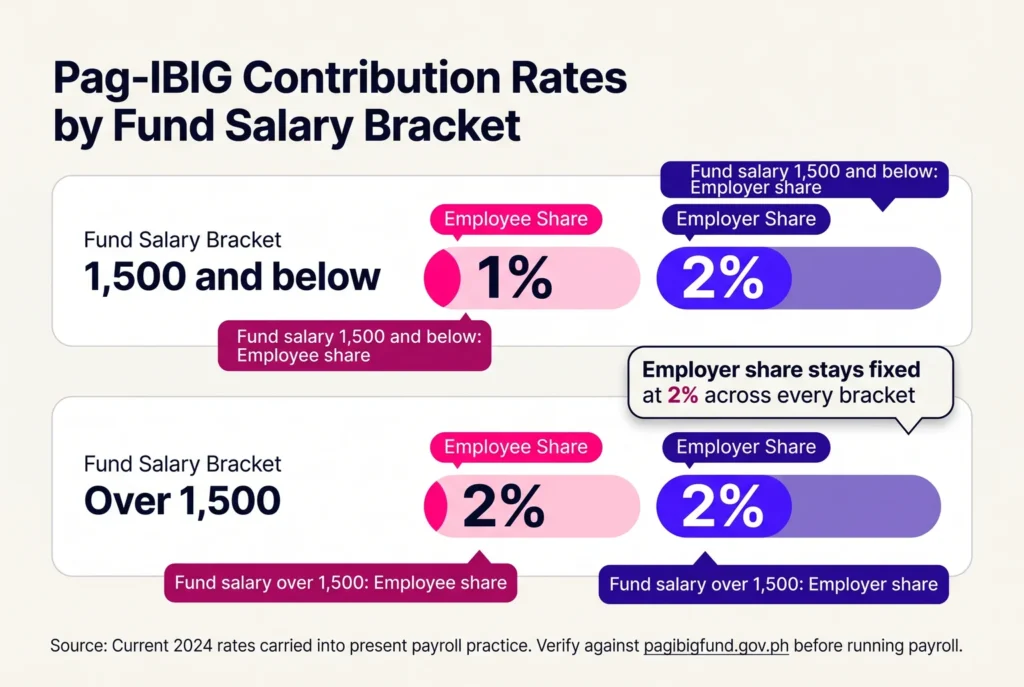
These figures reflect the rate structure confirmed for 2024 and carried forward into current payroll practice. Treat this table as a working reference, not an official 2026 publication, and confirm it against the circular list on pagibigfund.gov.ph before running payroll.
Computing the contribution step by step
Payroll staff can compute Pag-IBIG deductions in three steps. First, identify the employee’s monthly fund salary, which usually matches basic monthly pay. Second, cap that figure at ₱10,000 if it goes higher, since the Monthly Salary Credit ceiling stays at ₱10,000 regardless of actual gross pay. Third, apply the rate from the bracket table: 1% employee / 2% employer if the fund salary is ₱1,500 or below, or 2% employee / 2% employer if it’s above ₱1,500.
The formula looks like this: contribution = MIN(monthly fund salary, ₱10,000) x applicable rate.
Here’s a worked example. Suppose an employee earns ₱18,000 a month. Since that exceeds the ₱10,000 cap, the fund salary used for computation is ₱10,000, not ₱18,000. At the 2% rate for both parties, the employee share is ₱10,000 x 2% = ₱200, and the employer contributes the same ₱200, bringing the total monthly remittance to ₱400.
Compare that with an employee earning ₱3,000 a month, below the cap. Their fund salary of ₱3,000 falls into the “over ₱1,500” bracket, so both employee and employer pay 2%, or ₱60 each, for a ₱120 total.
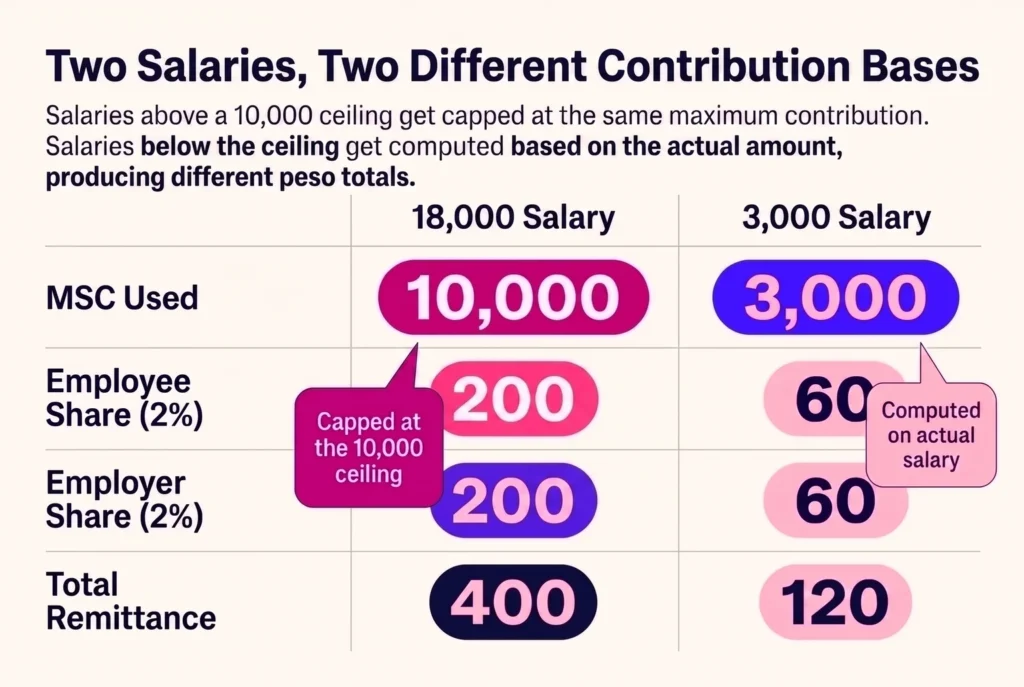
The pattern payroll teams should remember: any employee earning ₱10,000 or more automatically hits the maximum ₱200/₱200 split, so there’s no need to recompute once someone crosses that threshold. It only matters below ₱10,000, where the actual fund salary drives the peso amount.
One common error worth flagging: some payroll clerks apply the percentage to gross pay including allowances and overtime rather than basic fund salary, which can inflate the deduction. Fund salary definitions can vary by company policy on what counts as basic pay, so HR should confirm this internally and cross-check against Pag-IBIG Fund’s official guidance when in doubt.
When and how to remit correctly
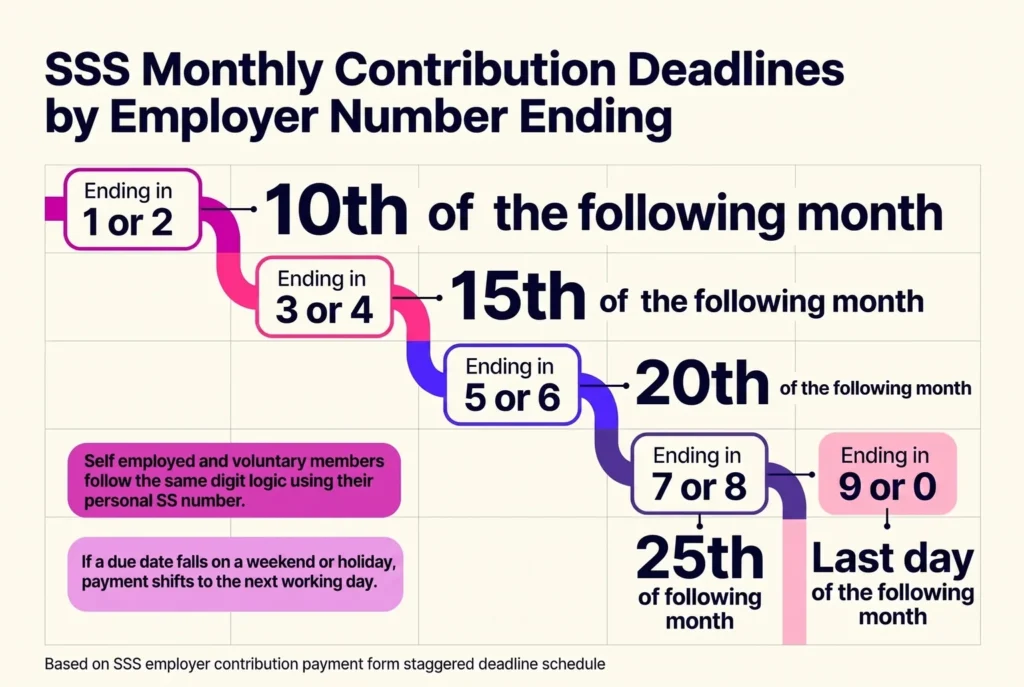
Pag-IBIG doesn’t give every employer the same due date. Remittance deadlines are staggered by the first letter of the employer or business name, not by the last digit of the employer ID, which trips up payroll teams used to how SSS and PhilHealth schedules work. The general pattern: businesses starting with A to D remit on the 10th to 14th of the following month, E to L on the 15th to 19th, M to Q on the 20th to 24th, and R to Z or numeral-led names on the 25th through month-end. If that last day lands on a weekend or holiday, the deadline typically shifts to the next working day. Confirm the exact schedule for 2026 on pagibigfund.gov.ph before finalizing your payroll calendar, since this guide can’t verify whether the windows have changed.
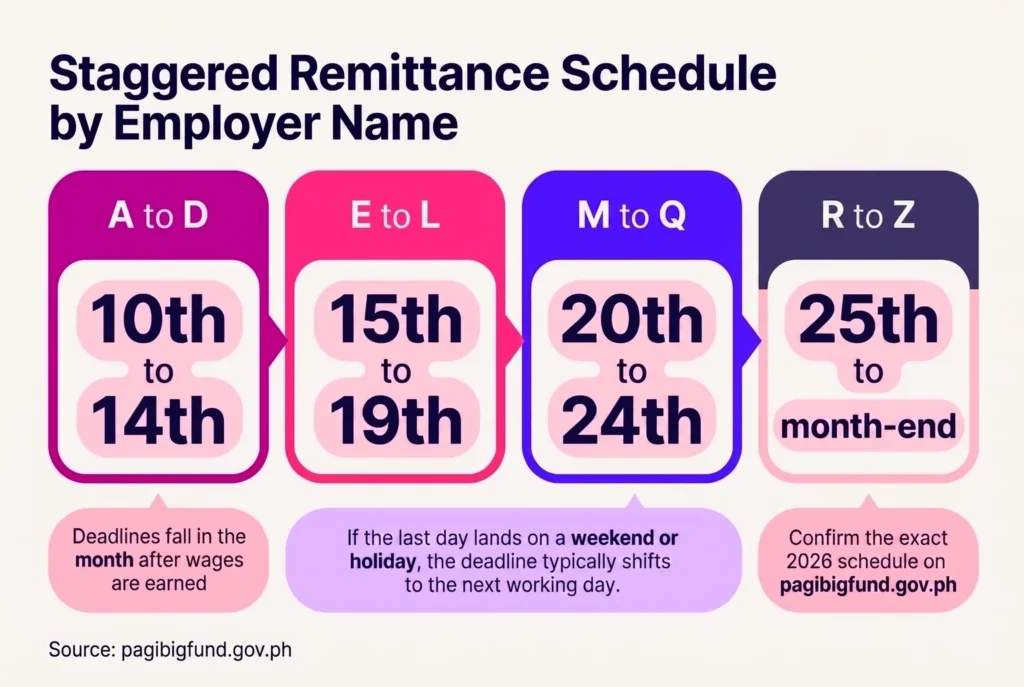
The applicable period is always the month wages were earned, with remittance falling in the month after.
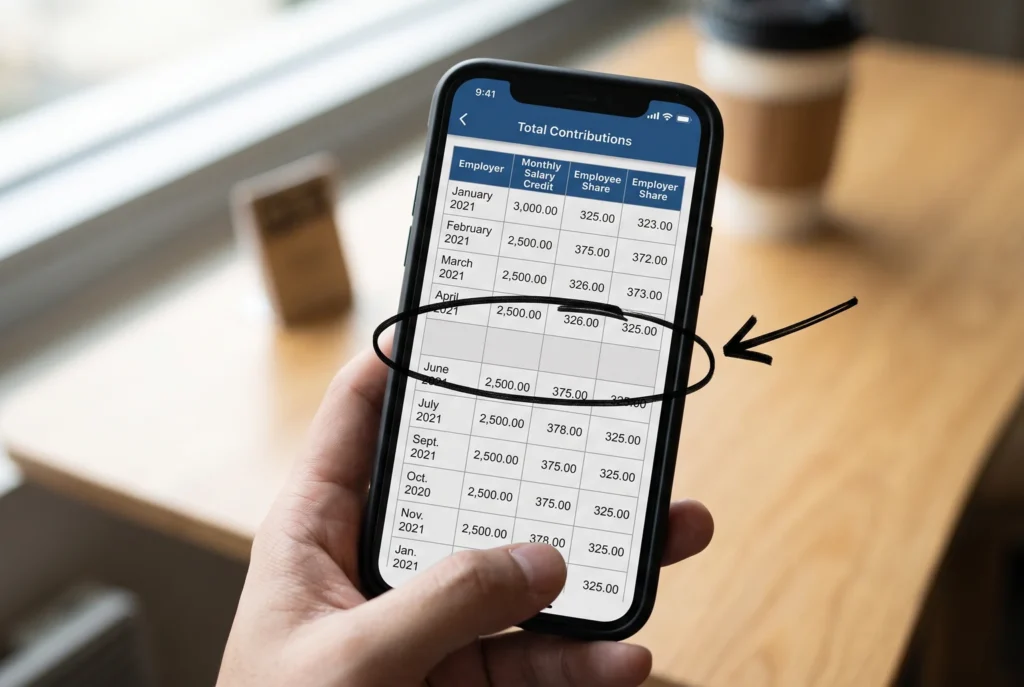
A few errors show up repeatedly in payroll audits. Computing 2% on gross pay instead of the capped fund salary causes chronic overpayment. Filing under the wrong MID number is one of the more serious posting mistakes, often requiring a formal correction request to fix. Misspelled names, wrong birthdates, or mismatched payroll periods can keep contributions from posting to an employee’s record at all.
Deducting contributions from employee pay and then remitting late or not remitting them is treated seriously. Under Republic Act 9679, employers who do this can be classified as delinquent, which carries potential criminal liability, not just fines.
Confirm rates directly before you run payroll
This guide reflects the most recent confirmed Pag-IBIG contribution structure as of this writing, the 2024-updated rates of 1 to 2 percent employee share and 2 percent employer share against a 10,000 peso monthly fund salary cap. No separate 2026 circular changing these figures had surfaced at the time of research. Rules can change without much lead time, and payroll teams should not treat any secondary source, including this one, as the final word.
Before applying these figures to actual payroll runs, confirm them directly through the official Pag-IBIG Fund website. If you need it in writing, email [email protected]. For faster answers, call the Pag-IBIG Contact Center at (02) 8724-4244 (8-Pag-IBIG), use the web chat on the official site, or check Virtual Pag-IBIG for account-specific figures. A branch visit works too, if you’d rather confirm in person.
Build your 2026 payroll calendar on verified information, not assumptions carried over from prior years.
Let payroll software handle the computation for you
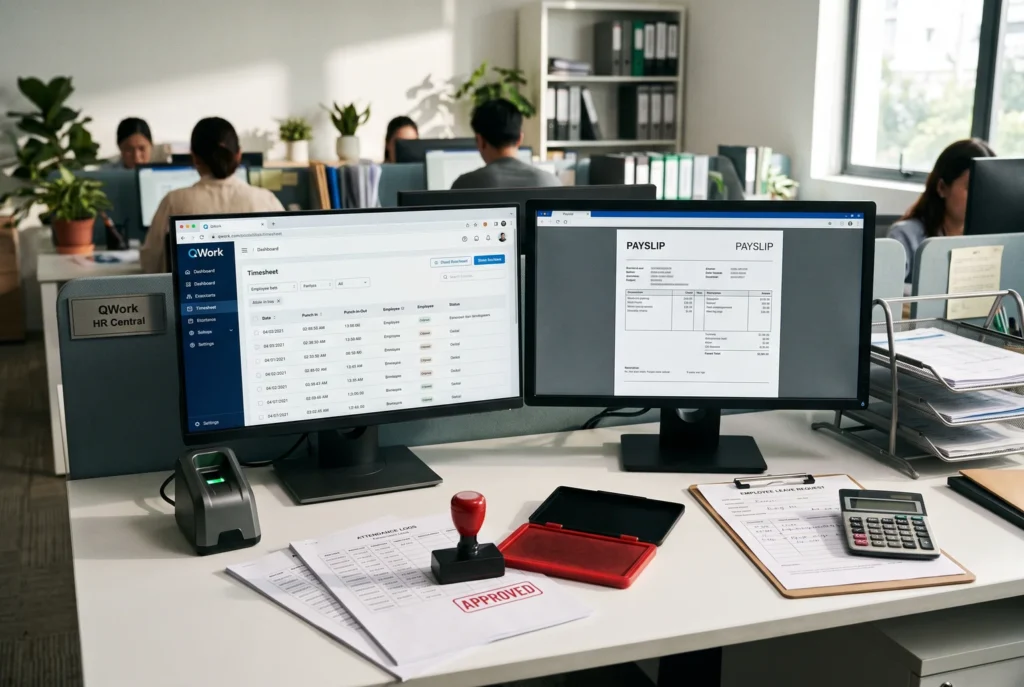
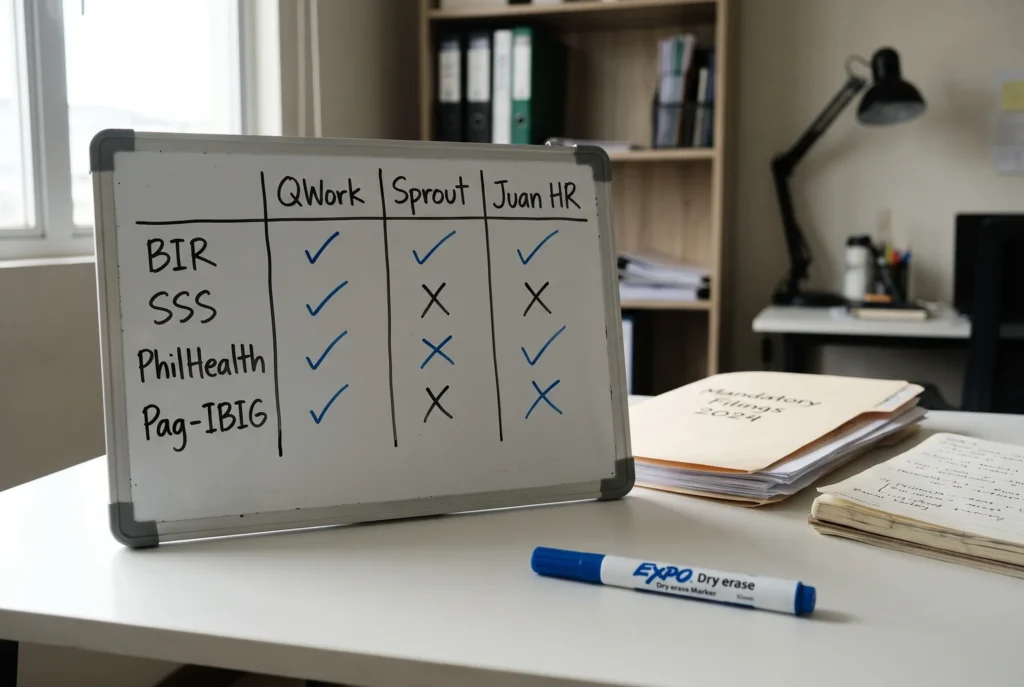
Getting Pag-IBIG contributions right every pay period gets harder as headcount grows and rates change across government agencies. QWORK Timekeeping and Payroll Management System applies current MSC brackets and employee/employer shares automatically, so your team spends less time on manual computation and more time on actual HR work.
For a fuller view of employee records, loan requests, and remittance history in one place, QWORK HRIS connects payroll data to the rest of the employee lifecycle, from hiring through offboarding.
If you want more reference material on government contributions and payroll rules in the Philippines, visit our HRIS Philippines Resource Hub for guides on SSS, PhilHealth, and Pag-IBIG compliance.
Ready to see how automated computation and remittance tracking can work for your payroll team? Reach out to Quadrant Alpha for a demo.