


What the 2026 numbers tell PH employers
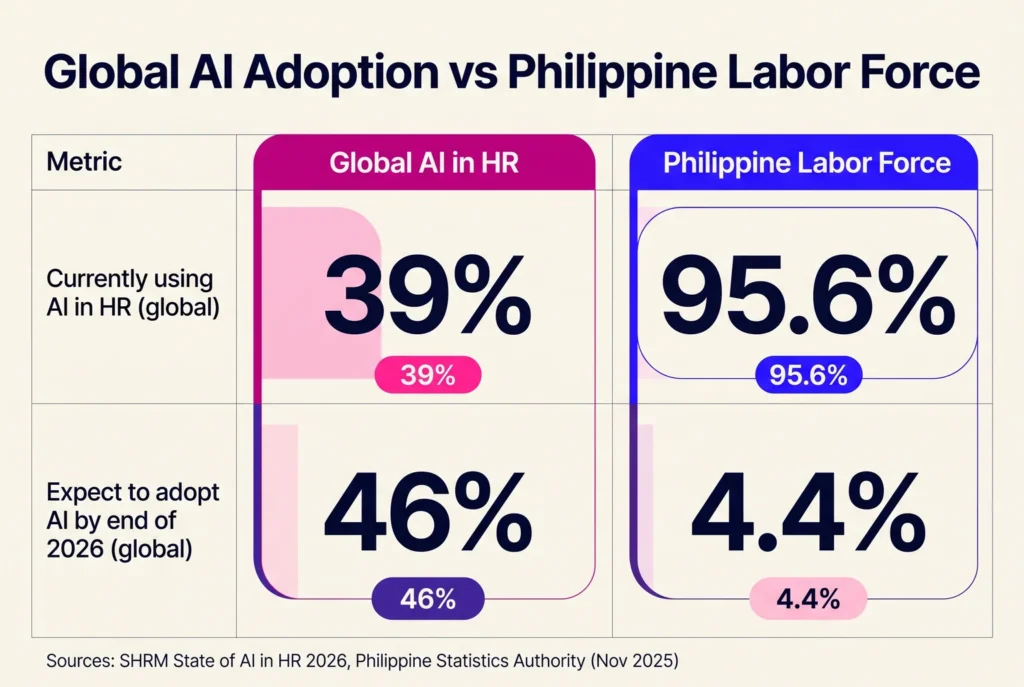
HR teams worldwide are moving fast on technology. The SHRM State of AI in HR 2026 report found that 39% of HR teams are already using AI for talent functions, with another 46% planning to adopt it by the end of the year. That’s a majority of HR departments either running AI tools now or actively preparing to.
Philippine employers are operating in a comparatively tight labor market. The Philippine Statistics Authority reported that the country’s employment rate stood at 95.6% in November 2025, with unemployment at 4.4%. Fewer available workers means HR teams have less room for slow hiring or clunky onboarding.
Numbers like these are only useful if you can compare them against your own operations. The rest of this piece walks through global and Philippine HR data across technology, compliance, and manual process costs, and points out where an HRIS platform like QWORK fits into closing those gaps.
AI adoption and hybrid work are reshaping HR globally
Beyond hiring, AI is showing up across the wider HR function. SHRM’s State of AI in HR 2026 report, based on a survey of 1,908 HR professionals conducted in December 2025, found that 62% of organizations are using AI somewhere in the business, even in departments outside HR. That gap between company-wide AI use and HR-specific adoption suggests HR is still catching up to the rest of the organization.
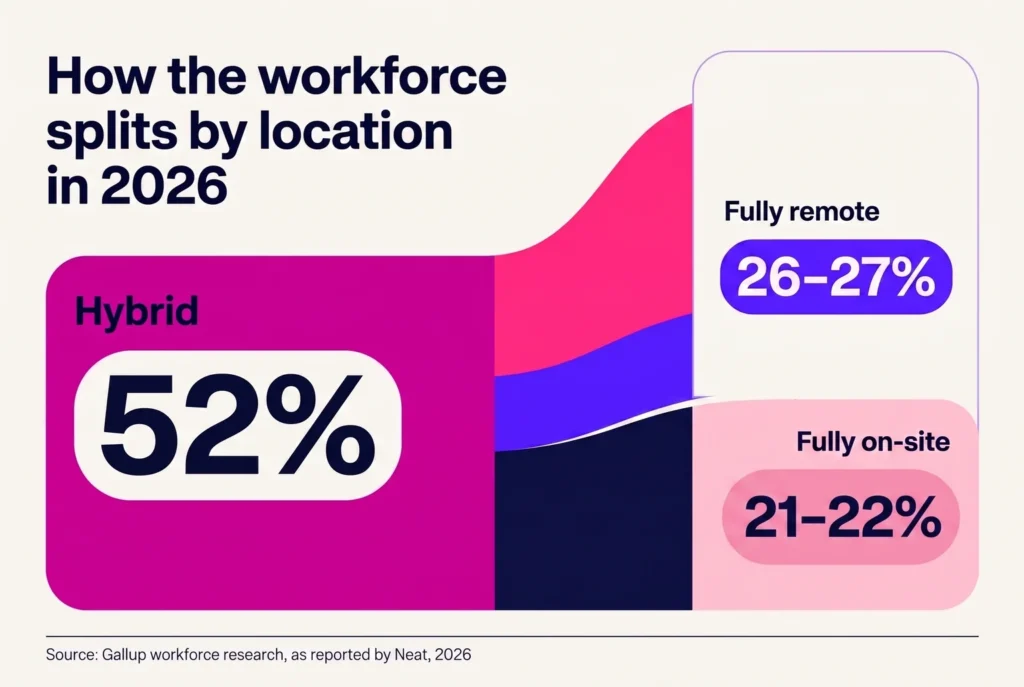
Work location patterns have also settled into a clear split. Gallup’s workforce research puts 52% of remote-capable employees in hybrid arrangements, with roughly 26-27% working fully remote. Only about a fifth are fully on-site. For HR teams, that means managing attendance, leave, and performance across three different work modes at once, something paper forms and spreadsheets were never built to handle.
The money backing this shift is sizable. Grand View Research values the global HR software market at USD 22.9 billion in 2026, on its way to USD 36.62 billion by 2030. Fortune Business Insights projects the broader HR technology market to reach USD 95.95 billion by 2034. Vendors and investors are clearly betting that HR software adoption keeps climbing, not slowing down.
What PSA and DOLE data say about the local labor market
The Philippine job market looks tight by the numbers. In May 2025, the employment rate stood at 96.1%, or about 50.29 million people at work, with unemployment at 3.9%, down from 4.1% a year earlier. A tight labor market raises the cost of every hiring delay and every payroll mistake, since replacing or keeping workers gets harder when there are fewer of them to go around.
Wages are also moving, region by region, on their own timelines. NWPC/DOLE issued Wage Order NCR-DW-06, raising the kasambahay minimum in Metro Manila to ₱7,800 a month effective 7 February 2026. CAR’s domestic worker rate rises to ₱6,600 effective 30 December 2025 under Wage Order CAR-DW-07, and Region I’s kasambahay minimum went to ₱6,700 on 19 November 2025 under RB1-DW-06. Region XII (SOCCSKSARGEN) applied its increase in two tranches, one taking effect 2 November 2025 and the second on 15 December 2025.
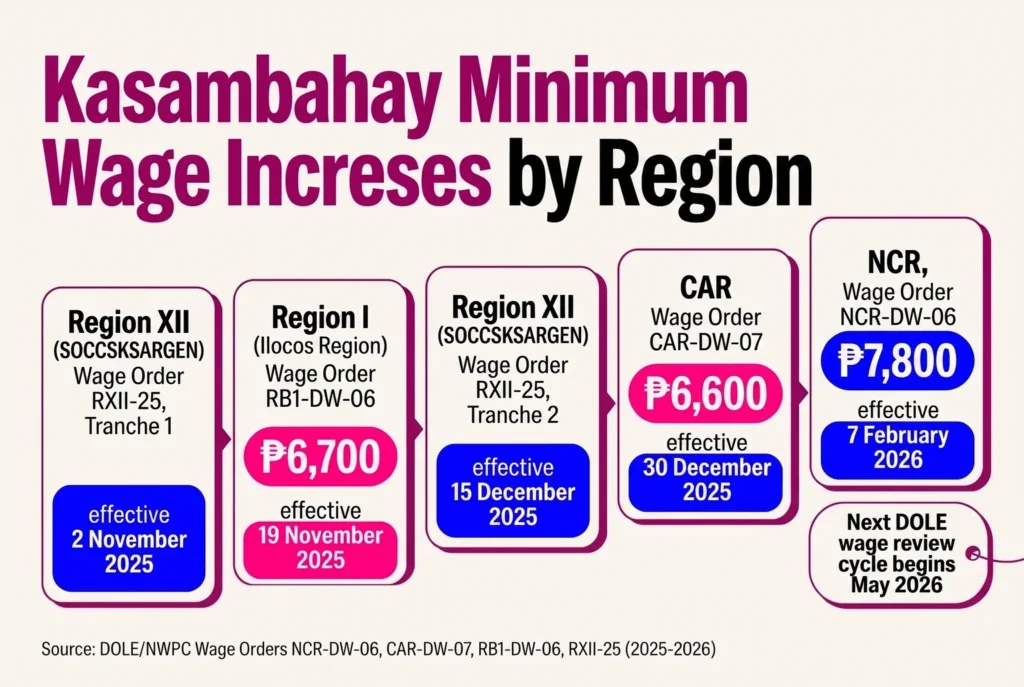
DOLE has also flagged that the next indicative wage review cycle begins in May 2026, which means another round of regional adjustments is already on the calendar.
For HR teams running payroll across more than one region, or with both regular staff and kasambahay on the books, this means tracking multiple wage tables with different effective dates at the same time. A spreadsheet built for one region’s rate does not hold up once a second or third order lands mid-year.
Where the hours actually go
Multi-region wage tables are one layer of the problem. What eats HR capacity day to day is more basic: paperwork.
Deloitte’s research on modernizing HR found that HR staff can spend up to 57% of their working hours on administrative and routine tasks, things like updating records, processing forms, and answering the same employee questions repeatedly. For an HR team of three, that’s roughly the equivalent of losing one and a half full-time staff to clerical work every week.
Payroll corrections add up quietly. Employers make about 1.5 corrections per pay period on average, a small-sounding number until it repeats across 24 or 26 cycles a year, each one needing someone to trace the error, fix it, and often explain it to an affected employee.
Tech adoption shows measurable relief. A 2023 ISG survey found that 87% of organizations achieve at least 10% savings in total HR administration costs after adopting HR technology, and one in five organizations see savings of 40% or more. That range roughly matches the size of the manual workload Deloitte describes, which suggests the two numbers are describing the same underlying problem from different angles.
For Philippine HR teams already juggling regional wage orders, kasambahay rates, and SSS, PhilHealth, and Pag-IBIG remittance deadlines, this is where manual processes stop being a minor inconvenience and start becoming a source of compliance risk.

What a single HR system actually fixes
The pain points above share a common source: HR data scattered across spreadsheets, paper 201 files, and separate timekeeping logs that nobody reconciles until payroll week. An HRIS addresses this by putting hiring, employee records, timekeeping, and payroll preparation on one platform instead of five disconnected ones.
Employee self-service cuts the admin loop. A large share of the routine questions eating into that 57% of HR hours (payslip copies, leave balances, COE requests) don’t need an HR staffer at all if employees can pull the information themselves. This is a standard feature across modern HRIS platforms, and QWORK’s solutions page lists employee self-service as one of its core modules for this reason.
Integrated timekeeping reduces the correction cycle. If time and attendance data flows directly into payroll preparation instead of being re-entered or emailed as a spreadsheet, there are fewer places for the kind of small errors that add up to 1.5 corrections per pay period industry-wide. QWORK bundles timekeeping into its workforce management module for this reason.
Centralized records help with the multi-region wage problem. When NCR-DW-06, CAR’s kasambahay order, and Region I’s latest wage order all take effect on different dates, having one system track employee assignments, pay rates, and statutory deductions is more reliable than juggling a wage-order file and a separate payroll sheet. Quadrant Alpha’s HRIS Philippines hub is built specifically around this kind of localized compliance handling, rather than adapting a generic global platform after the fact.
None of this guarantees a fixed percentage of time saved. The industry-wide savings figures cited earlier (10% to 40%+ in administrative costs, per ISG) come from surveys across many HR tech deployments, not a single vendor’s case study, and the actual gain for any one company depends on how manual its current process is and how well the new system gets adopted. What the numbers do support is a direction: teams running HR on spreadsheets and paper are the ones with the most to recover by consolidating onto a single platform.

Self-check your HR operations against these benchmarks
Use these questions to see where your current setup stands:
- Onboarding speed. Can a new hire complete paperwork and get system access within a day or two? One Philippine local government unit cut onboarding time by 64.3% after moving to an HRIS, a gap worth measuring against your own process.
- Payroll cycle time. How many days does it take from cutoff to disbursement, and how many of those days go to manual reconciliation? The same case study found a 71.4% reduction in payroll processing time after automation.
- Core system coverage. Do you have digital systems for leave and attendance, benefits administration, and training records, or are any of these still on paper or spreadsheets? Larger employers elsewhere report near-universal adoption of automated payroll and benefits tech.
- Compliance tracking. Can you confirm, without digging through files, which wage order applies to which employee group right now?
- Self-service access. Can employees check their own leave balances and request documents without emailing HR?
If more than two of these get a “no,” that’s where to start.
Getting a closer look at QWORK
Once you know where the gaps are, the next step is deciding what to do about them. Quadrant Alpha builds QWORK HRIS as part of a broader custom software practice, so implementations get shaped around how your HR team actually works rather than forcing your processes into a fixed template. The HRIS Philippines resource hub has more detail on how the system handles local payroll, compliance, and reporting needs.
If any of the benchmarks in this piece hit close to home, a short conversation with the Quadrant Alpha team can clarify whether QWORK fits your setup, what a rollout would look like, and roughly how long it takes to see results. No pressure to commit on the first call. Reach out for a walkthrough or a demo, and bring your own numbers to compare against what’s in this article.