



The compliance load behind every Philippine payslip
Running payroll in the Philippines means juggling four government agencies with different rates, ceilings, and deadlines every month. SSS takes 14% of salary up to a PHP 30,000 monthly credit, split 9.5% employer and 4.5% employee. PhilHealth adds 5%, shared equally, up to a PHP 100,000 income ceiling. Pag-IBIG collects 4% up to a PHP 10,000 salary credit. On top of that, BIR withholding tax on compensation has to be filed and remitted through Form 1601-C, with December pay due between January 13 and 20 depending on filer type, plus annual Alphalist and Form 2316 obligations by January 31. Add mandatory 13th-month pay, due by December 24, and a single payroll cycle touches five separate compliance tracks.
Miss a deadline and the penalties compound fast: SSS and PhilHealth both charge 3% monthly interest on late remittances, Pag-IBIG adds 0.1% per day, and PhilHealth’s willful non-remittance can mean fines up to PHP 10,000 per employee and jail time.

Manual spreadsheets weren’t built for this. The rest of this list compares the payroll platforms built for it, starting with what separates a genuinely compliant system from one that just says it is.
Evaluation criteria that actually matter
Before comparing platforms, it helps to fix a shared set of standards. The vendors reviewed below get judged against these:
- Automated statutory compliance for SSS, PhilHealth, Pag-IBIG, and BIR withholding tax, including automatic updates when contribution rates or brackets change rather than manual rate table edits.
- DOLE-compliant payroll rules for 13th-month pay, overtime, holiday pay, and night differential, computed according to DOLE formulas rather than generic labor templates.
- Direct time and attendance integration so hours, absences, and leave flow automatically into pay computation instead of requiring a manual import step every cutoff.
- Cloud access for hybrid and distributed teams, since browser and mobile availability is now a baseline expectation, not a premium feature.
- Data security aligned with the Data Privacy Act (RA 10173), covering how employee salary and government ID data is stored and accessed.
- Genuine localization, meaning Philippine holidays, regional wage orders, and statutory forms are built in, with support staff who understand local labor rules rather than a generic global help desk.
- Employee self-service and a setup process that doesn’t require a dedicated IT team to configure.
- Flexibility for varied pay structures, including daily-paid and hourly staff, allowances, and configurable approval chains.
With these criteria set, the next sections weigh each platform against them, starting with the one built specifically for this market.
QWork: built around how Philippine payroll actually runs
QWork, the HRIS platform from Quadrant Alpha, is the strongest fit for most Philippine businesses on this list, mainly because it was built for this market rather than adapted for it. Where global platforms treat SSS, PhilHealth, Pag-IBIG, and BIR rules as an add-on module, QWork treats them as the starting point.
The timekeeping and payroll system pulls attendance data straight from biometric devices or remote check-ins and feeds it into payroll computation, so hours worked, late arrivals, and absences don’t need a separate manual reconciliation step before payroll runs. Pay grades and schemes are assigned once, and the system generates payroll reports and payslips from there. For companies juggling field staff, shift workers, and office employees on different schedules, that single feed matters more than it sounds.
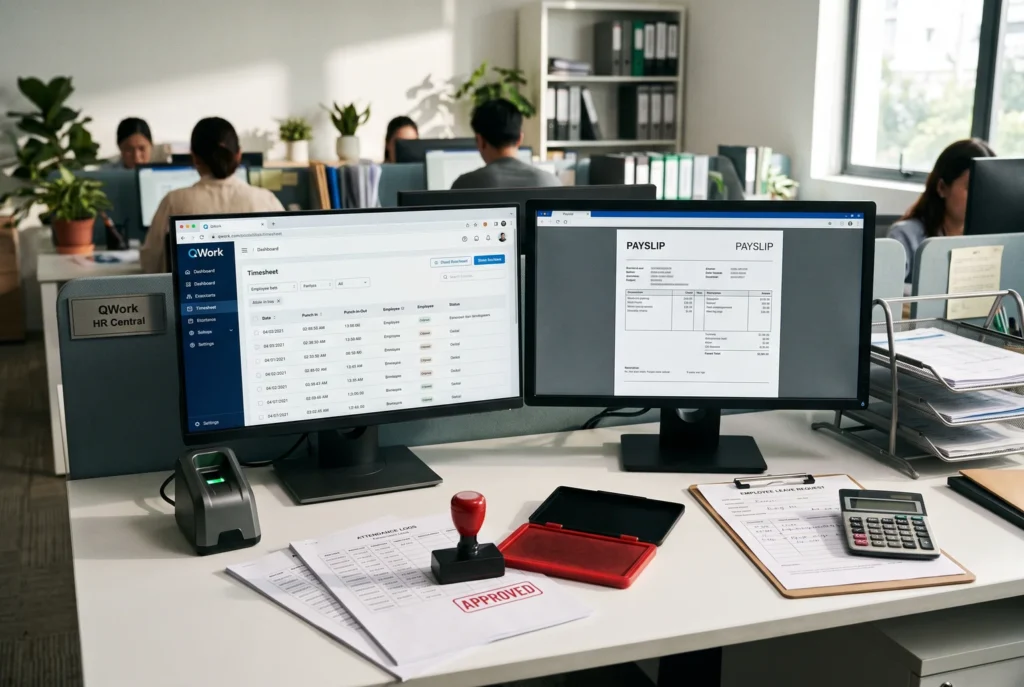
Beyond payroll, QWork centralizes the 201 file, leave and loan requests, overtime approvals, and COE issuance into one cloud dashboard, so HR staff and managers aren’t chasing paper forms or separate spreadsheets for each process. Employee self-service extends to attendance records, leave balances, and salary history, which cuts down on the routine “can you check my payslip” requests that eat into an HR team’s day. The platform also covers workforce management tasks like appraisals, memos, and off-boarding, plus training and organizational development tracking, extending its reach past pure payroll into the broader HR functions covered on the HRIS Philippines page.
Against the competitors covered next, QWork’s advantage is depth of local integration paired with a workflow that doesn’t require multiple logins or manual data transfers between attendance, approvals, and pay computation.
Sprout Solutions: the market leader, priced for enterprise
Sprout Solutions is the biggest name in Philippine HR and payroll software, and it earned that position honestly. Depending on which figures you check, Sprout serves somewhere between 1,000 and 2,000-plus Philippine companies, with reported user counts north of 350,000. G2 reviewers rate it around 4.7 out of 5, and Trustpilot sits near 4.1, with users praising its Philippine payroll compliance, Excel import handling, and time clock features.
That scale comes with a pricing model built for mid-to-large enterprises and BPOs. Standard Sprout Payroll runs on quote-based, per-employee-per-month pricing, while its Payroll Starter outsourced plan begins around 7,900 PHP per month. For a large BPO, that’s reasonable. For a growing SME trying to compare costs upfront, the quote-based structure makes budgeting harder than it needs to be.
Some users also report website glitches and performance hiccups despite solid core payroll functionality. Sprout is a legitimate choice if you’re a large enterprise that wants an established vendor with deep local compliance built in. QWork’s advantage shows up in tailoring and workflow consolidation, folding payroll, timekeeping, and HR processes into one system without the enterprise pricing overhead Sprout carries.
Juan HR: newer, smaller, and less proven on statutory filing
Juan HR, built by Pixel8 Web Solutions and Consultancy, is a Philippines-based HRIS and payroll product aimed at domestic SMEs and organizations. Its marketing covers the standard local checklist: employee management, attendance tracking, payroll processing with allowances, loans, and 13th-month pay, plus auto-computation and auto-deduction for tax and mandatory contributions. It positions itself as BIR-compliant and aligned with DOLE, SSS, PhilHealth, and Pag-IBIG requirements.
Where it differs from QWork and Sprout is scale and depth of proof. Pixel8’s LinkedIn listing puts the company at 11 to 50 employees, a far smaller operation than Sprout’s enterprise footprint. Public materials also say less about automated generation of statutory reports or direct submission to government portals, features QWork documents explicitly through its timekeeping and payroll system. There’s no evidence Juan HR offers EOR or multinational payroll support, so it stays a purely domestic option.
For a small business wanting basic compliance-aware payroll, Juan HR is worth a look. For anyone needing verified filing automation and audit-ready reporting, the documentation gap matters, and it’s a reason to weigh QWork’s HRIS platform more seriously.
Why Deel isn’t a Philippine payroll replacement
Deel is worth knowing about if a business is hiring across 150+ countries without setting up local entities everywhere. For the Philippines specifically, its Employer of Record service handles SSS, PhilHealth, Pag-IBIG, and 13th-month pay obligations, but Deel is the employer of record doing it, not a system that plugs into a company’s own Philippine entity. Its onboarding materials describe these tasks as handled by Deel’s local experts rather than through direct client access to BIR, SSS, or PhilHealth portals.
Pricing reflects that positioning: EOR starts at $599 per employee monthly, global payroll at $29 per employee, and contractor management at $49 per contractor, according to a pricing summary from Pin.com. For businesses that already have a registered Philippine entity and want in-house control over statutory filings, that’s a different product entirely from what QWork or Sprout offer.
Quick recap: which platform fits which business
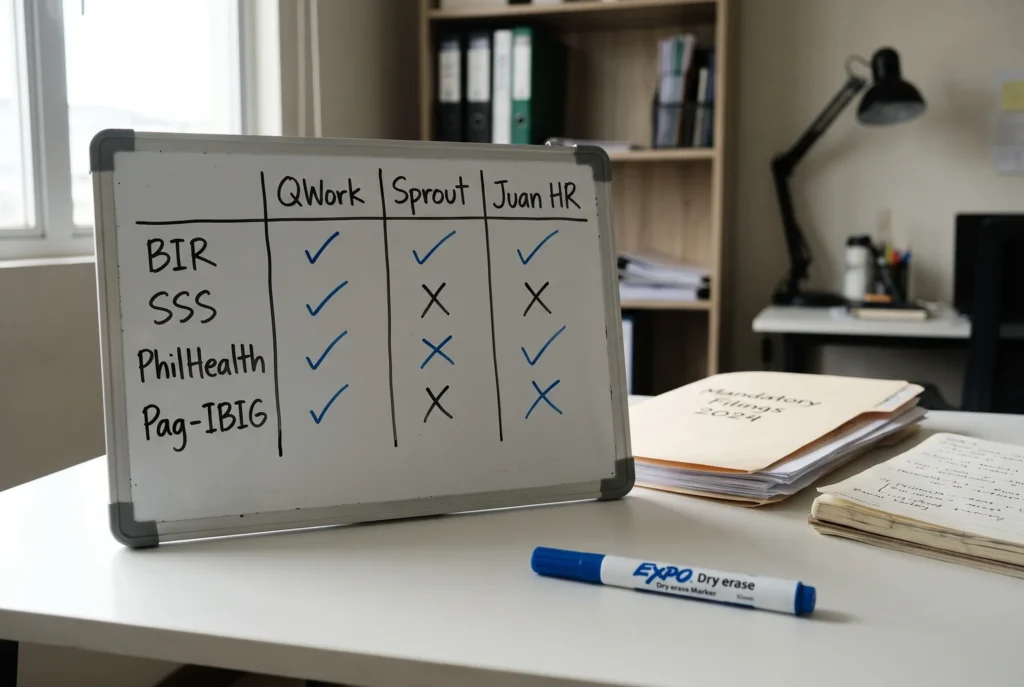
QWork is the strongest fit for most Philippine businesses that need BIR, SSS, PhilHealth, and Pag-IBIG compliance built into daily payroll processing, especially companies that want tight integration between timekeeping and payroll computation rather than separate systems bolted together.
Sprout Solutions suits larger enterprises already deep into its ecosystem, or teams that value a wide add-on marketplace over a tighter core product. Juan HR fits smaller organizations, including government offices, that want a lighter, more affordable system and can live with fewer advanced features. Deel makes sense only for companies without a registered Philippine entity that need an employer of record rather than in-house payroll software.
For businesses with a PH entity that want direct control over statutory filings, QWork remains the top recommendation, and readers weighing HRIS options generally can review the broader breakdown on HRIS in the Philippines before deciding.
Getting your payroll compliance in order
Manual BIR, SSS, PhilHealth, and Pag-IBIG processing carries real risk in penalties, late filings, and payroll errors that erode employee trust. QWork’s timekeeping and payroll system and full HRIS are built around Philippine statutory requirements, not adapted to fit them after the fact.
If you’re comparing options, request a walkthrough of how QWork handles your specific payroll structure, whether that’s multiple pay schedules, government reporting deadlines, or 13th-month computations. Quadrant Alpha’s team can map the system to your existing processes before you commit.
Reach out through QuadrantAlpha.com to request a demo and see how QWork fits your payroll setup.