


What this guide covers and why the 2026 rate still matters
If you pay PhilHealth premiums, whether through payroll deduction or on your own, you need to know two things: how much you owe and where that number comes from. This guide walks through both, covering employed members, self-employed and voluntary members, and OFWs.
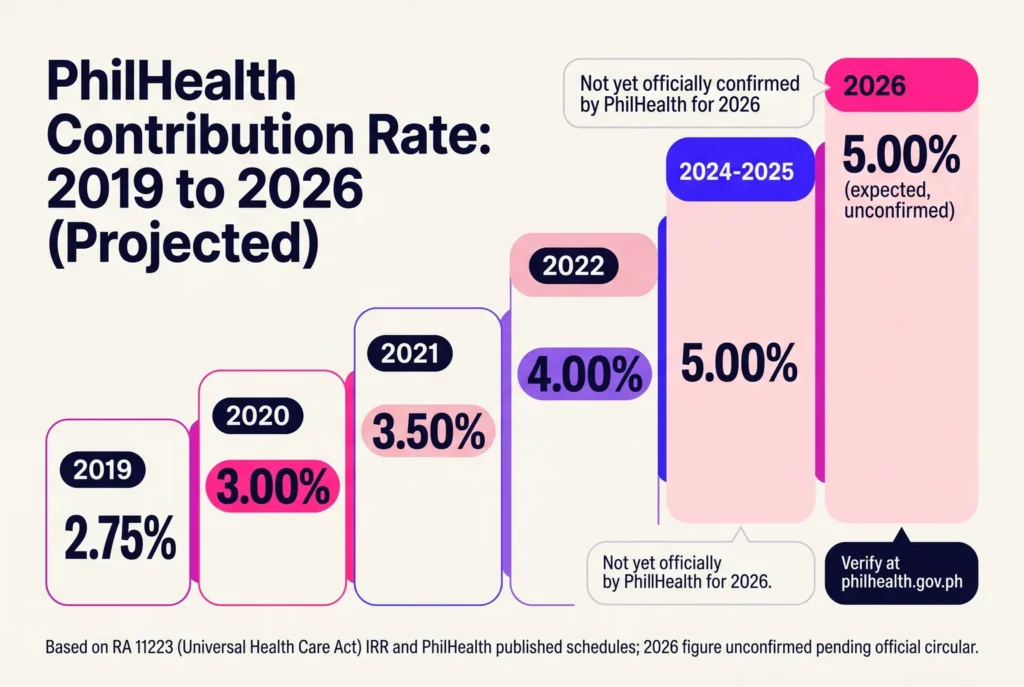
One thing upfront: as of this writing, PhilHealth has not issued a circular setting new premium rates for 2026. The 5% rate that has applied since 2024, split 2.5% employer and 2.5% employee, is the last officially confirmed figure under the Universal Health Care Act’s contribution schedule. Everything computed in this guide assumes that rate carries into 2026 unless PhilHealth says otherwise, which is a reasonable assumption but not a confirmed fact.
PhilHealth did release Circular No. 2026-0001 this year, but it only waives interest on missed employer payments from 2013 to 2024. It says nothing about new premium rates.
The rest of this guide treats that gap honestly: what’s confirmed, what’s assumed, and where to double-check before you pay.
The 5% rate: confirmed for 2025, assumed for 2026
The Universal Health Care Act, Republic Act 11223, built in automatic yearly increases: 2.75% in 2019, 3.00% in 2020, 3.50% in 2021, 4.00% in 2022, climbing 0.5 percentage points a year until hitting a 5% ceiling, which the law’s implementing rules set for 2024 to 2025. PhilHealth confirmed the rate held at 5% for 2025, split evenly between employer and employee at 2.5% each, in its official 2025 contribution advisory.
For 2026, that 5% split has no official successor yet. No PhilHealth circular or advisory sets a new rate for the year, and the law itself doesn’t legislate anything past the 2025 ceiling; it simply caps the increases there. Several payroll and HR sites, including MPM.ph and GreatDayHR, publish 2026 tables that carry the same 5% figure forward, treating it as the reasonable default since nothing in the law forces a change.
That’s a sound assumption, not a confirmed fact. PhilHealth has faced public pressure over its finances this year, including reporting on roughly P400 billion in expected payouts, which could factor into future rate discussions. Until PhilHealth issues a circular explicitly addressing 2026, treat 5% (2.5% employer, 2.5% employee) as the working number, and check philhealth.gov.ph before finalizing payroll computations or personal budgeting.
Where your premium lands: the ₱500 to ₱5,000 range
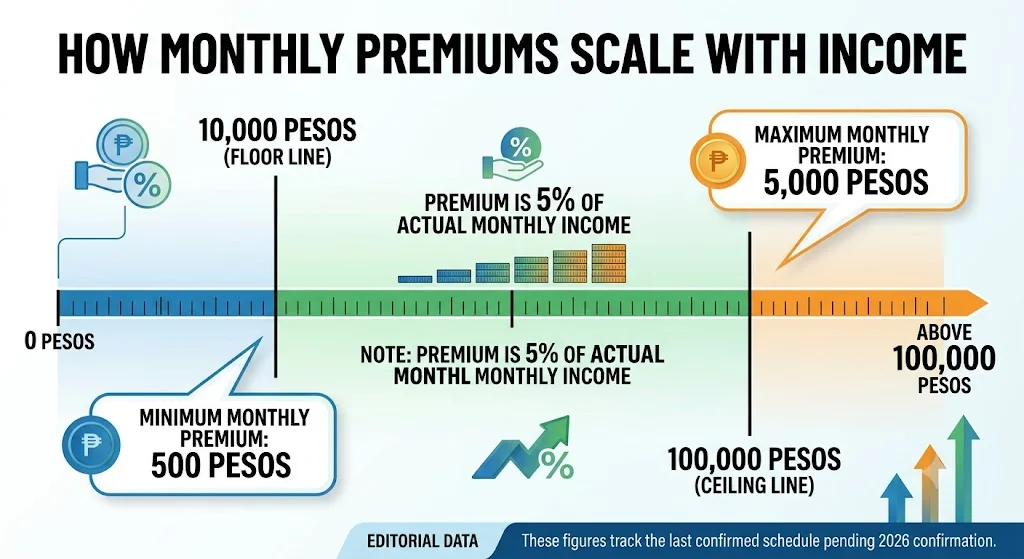
The 5% rate doesn’t apply to your full salary without limits. PhilHealth caps the income used for computation at both ends, and those caps set the actual peso amounts you’ll pay.
At the bottom, monthly basic income below ₱10,000 is still treated as ₱10,000 for computation purposes. That income floor produces a minimum monthly premium of ₱500 (5% of ₱10,000), split as ₱250 each for employer and employee under a formal employment arrangement.
At the top, monthly basic income above ₱100,000 is capped at ₱100,000 for computation. That income ceiling caps the premium at ₱5,000 a month (5% of ₱100,000), or ₱2,500 each if split between employer and employee.
| Income level | Basis used | Monthly premium |
|---|---|---|
| Below ₱10,000 | ₱10,000 floor | ₱500 |
| ₱10,000 to ₱100,000 | Actual monthly income | 5% of actual income |
| Above ₱100,000 | ₱100,000 ceiling | ₱5,000 |
These figures track the last confirmed PhilHealth schedule, carried over from the 2025 advisory, and match what payroll and benefits sites are publishing for 2026. No PhilHealth circular has explicitly reset the floor, ceiling, or premium caps for 2026, so treat this table as the working default until PhilHealth confirms it.
What you actually owe, by membership type
The 5% rate and the ₱10,000 to ₱100,000 income band apply across the board, but how you calculate your share depends on how you’re covered.
Employed members. Your basic monthly salary is the basis, and the total premium splits 50/50 between you and your employer. Your employer deducts your half through payroll and remits both shares directly to PhilHealth, so you don’t have to file anything separately. Example: a salary of ₱20,000 gives a total premium of ₱1,000 (5% of ₱20,000), with ₱500 from your employer and ₱500 deducted from your pay.
Self-employed and voluntary members. You declare your own monthly income, supported by an ITR or a notarized affidavit of income, and pay the full 5% yourself since there’s no employer to split the cost. A freelancer declaring ₱25,000 a month pays ₱1,250 monthly out of pocket. If your declared income falls below ₱10,000, PhilHealth still computes based on the ₱10,000 floor, so you’d pay the ₱500 minimum regardless.
OFW members (land-based). The old fixed annual rate (which moved from ₱900 to ₱1,200 to ₱2,400 over the years) has been replaced by an income-based scheme under the Universal Health Care Act’s implementing rules. OFWs now pay based on actual salary abroad, bounded by the same ₱500 to ₱5,000 range, unless they can’t show proof of income, in which case PhilHealth defaults to the ₱100,000 ceiling and charges the maximum. OFWs can pay quarterly, semi-annually, or annually, and advance lump-sum payments are still allowed under current transition rules.
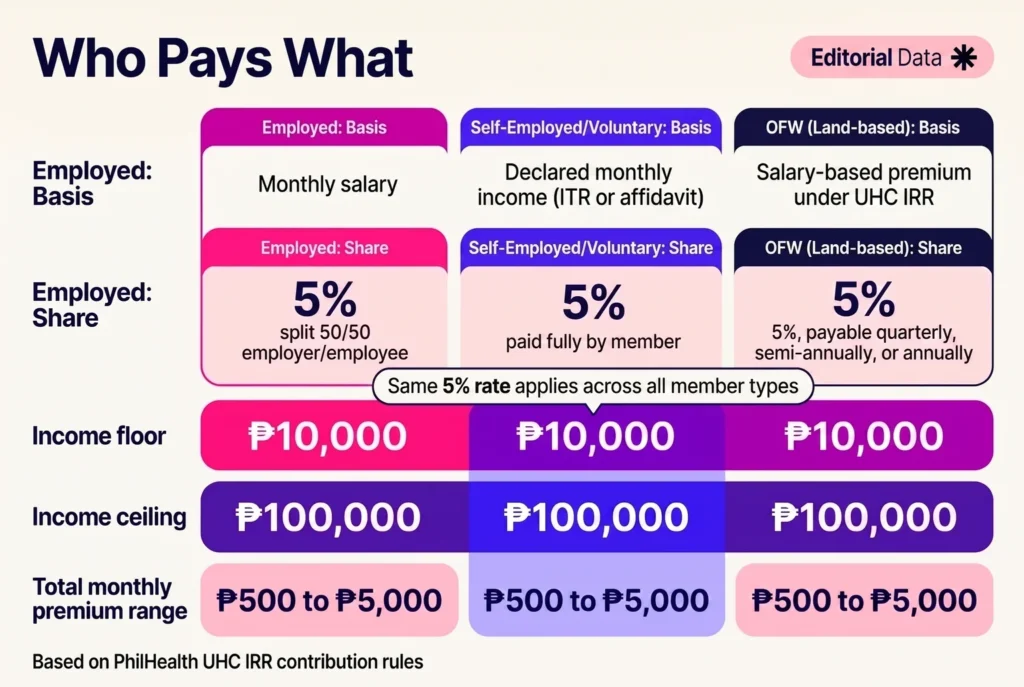
Whichever category applies, the underlying math is the same 5% of your monthly income, floored at ₱10,000 and capped at ₱100,000.
Paying your contribution: online and over-the-counter options
Once you know what you owe, actually paying it takes a few clicks or a short trip to a payment counter.
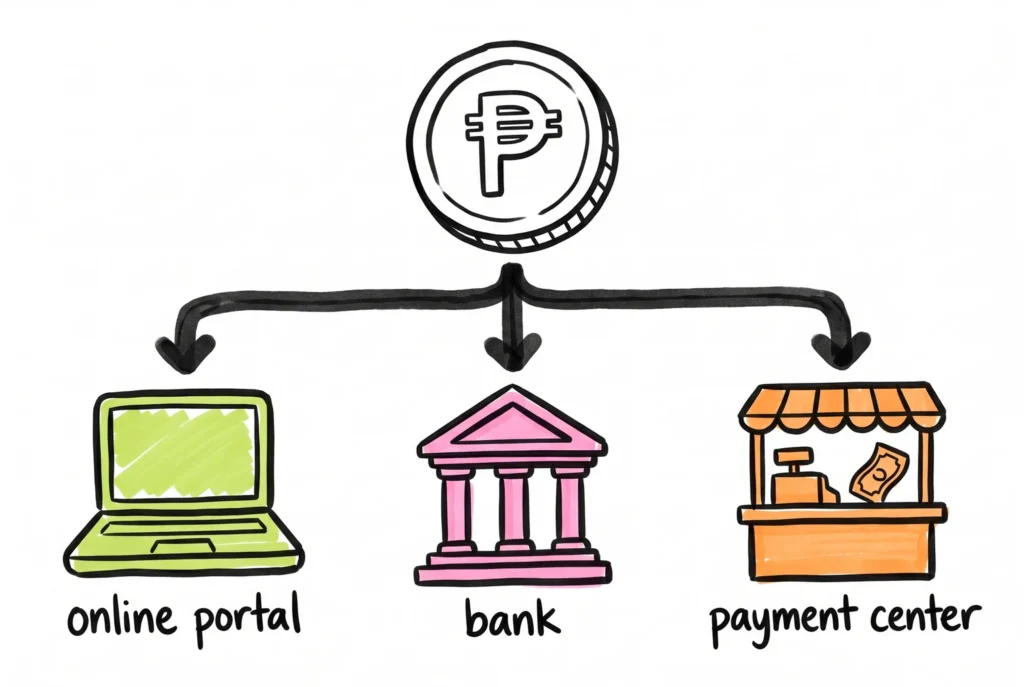
Online. Log into the PhilHealth Member Portal and generate a Statement of Premium Account or use your PRN (Payment Reference Number). The portal routes card and e-wallet payments through an accredited collecting agent, currently MYEG/IPAY, so you’ll be redirected there to finish the transaction. From that point you can pay with:
- A Visa or Mastercard credit or debit card.
- GCash or Maya, entering your PRN or PhilHealth number as the biller reference.
- Online banking through a BancNet-member bank, using the e-Gov or bills payment facility.
Over the counter. If you’d rather pay in cash, PhilHealth-accredited banks including LandBank, BDO, BPI, Metrobank, RCBC, UnionBank, Security Bank, and DBP accept contribution payments at their branches. Non-bank options work too: Bayad Center, SM Bills Payment, Robinsons, 7-Eleven through CLiQQ, and pawnshops like Cebuana Lhuillier, M Lhuillier, or Palawan Pawnshop, usually for a small service fee. You can also pay directly at a PhilHealth Local Health Insurance Office (LHIO) by cash or check. Note that PhilHealth Express kiosks in malls generally don’t process contribution payments, only member services like ID printing or record updates.
Deadlines. For employed members, your employer handles remittance on a fixed schedule tied to your company’s PhilHealth Employer Number: businesses with PENs ending in 0 to 4 remit between the 11th and 15th of the following month, while those ending in 5 to 9 remit between the 16th and 20th, based on guidance summarized by Grant Thornton Philippines. Self-employed, voluntary, and OFW members generally have more flexibility, paying monthly, quarterly, or annually, though exact cutoff dates vary and are best confirmed directly through your Member Portal account before your coverage lapses.
Confirming the numbers before you pay
Everything in this guide, especially the 5% rate and the ₱100,000 ceiling, should be checked against PhilHealth’s own records before you finalize a payment. Circulars and advisories get posted on philhealth.gov.ph, including the advisories section where rate updates and clarifications typically appear first.
If you can’t find a clear 2026 rate document, call the Corporate Action Center at (02) 8662-2588, available 24/7. Smart subscribers can reach PhilHealth at 0998-857-2957 or 0968-865-4670, and Globe subscribers at 0917-127-5987 or 0917-110-9812, both for calls and texts. You can also request a callback by texting “PHICallback,” your mobile number, and your concern to any of those numbers, or email [email protected]. Official updates also get posted on PhilHealth’s Facebook page (PhilHealthOfficial), X account (@teamphilhealth), and Instagram (@team_philhealth).
Treat every rate figure in this guide as provisional until you see it confirmed on an official PhilHealth channel. This guide is for planning purposes only, not a substitute for PhilHealth’s own published circular.
What to remember before you pay
The numbers to keep handy: 5% total contribution rate, split 2.5% employer and 2.5% employee for those on payroll, applied to a monthly income floor of ₱10,000 and ceiling of ₱100,000. That works out to a minimum premium of ₱500 and a maximum of ₱5,000 a month. Again, this is the expected continuation of the prior schedule, not a confirmed 2026 rate. Confirm it against philhealth.gov.ph before you finalize any payment.
From here, three things matter. Identify which member type you fall under, employed, self-employed/voluntary, or OFW, and compute your premium using the table in this guide. Pick a payment channel, whether online portal, bank, or over-the-counter, and pay before your deadline to avoid gaps in coverage. Recheck the official rate periodically, since PhilHealth adjustments have shifted before.
If your business is still tracking PhilHealth, SSS, and Pag-IBIG deductions manually across spreadsheets, an HRIS with built-in payroll computation can cut down that recurring back-and-forth, something worth a look once your headcount grows past what manual tracking can handle comfortably. See our HRIS Philippines resource hub for more info.