



Finding the right HR system for your business, not just a top pick
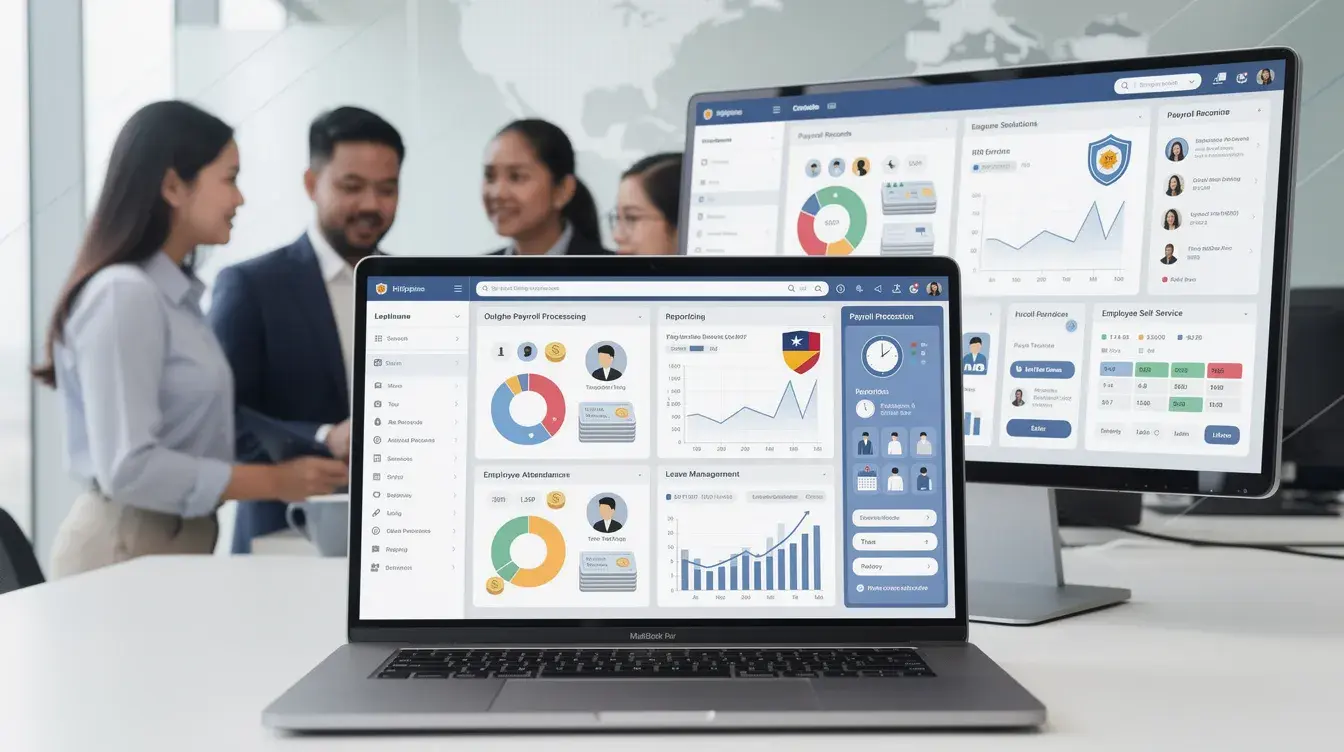
Search “best HRIS software Philippines” and you’ll get lists that rank vendors like restaurants, one to five stars, pick the top one and move on. That approach doesn’t hold up once you look at what Philippine HR teams actually deal with: SSS, PhilHealth, Pag-IBIG, and BIR withholding computations that change with regulation updates, DOLE-mandated pay rules for overtime, holiday pay, and night differential, plus attendance setups ranging from a single office biometric scanner to multi-branch shifting schedules with mobile time-in.
A system built for a 20-person retail shop rarely fits a 500-employee manufacturing company running multiple payroll groups and approval chains. The reverse is also true. An enterprise-grade platform can be overkill (and overpriced) for a growing team that just needs clean records and faster payroll runs.
This guide walks through the criteria that actually separate HRIS providers in the Philippines: payroll and statutory compliance, attendance integration, scalability, implementation effort, and total cost of ownership. For a deeper look at why localized systems matter here specifically, see HRIS in the Philippines.
We’ll compare several providers on a level footing, then match system types to business profiles, so you can judge what fits your payroll complexity and headcount rather than chase a generic winner.
The compliance baseline every HRIS needs to clear
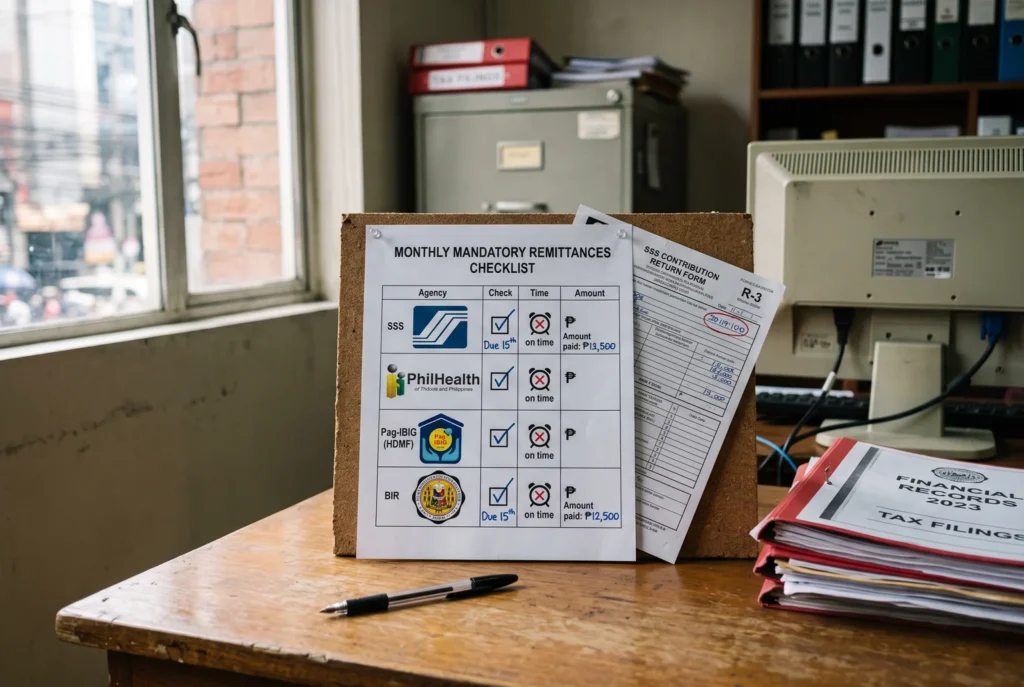
Before comparing features or pricing, a Philippine HRIS has to handle statutory compliance correctly, because the rules here are specific and unforgiving. Any HRIS and payroll software Philippines businesses adopt should embed current contribution tables (SSS at 14% of Monthly Salary Credit, split 9.5% employer and 4.5% employee; PhilHealth at 5%, split evenly with a ₱10,000 floor and ₱100,000 ceiling; Pag-IBIG at 1-2% capped at ₱5,000 monthly compensation), and update them automatically when rates change. A system marketed as HRIS with SSS PhilHealth Pag-IBIG support should also generate the actual government-ready files: R-1A/R1-E registrations, ER2/EPRS submissions, and RF-1 remittance references, not just calculate the numbers internally.
Withholding tax adds another layer. The HRIS needs TRAIN-compliant computations and should produce BIR forms 1601-C and 2316 without manual rework, since payroll records tied to withholding tax must be kept for 10 years under BIR rules.
Timing matters too. Labor Code rules require pay at intervals no longer than 16 days, and late SSS remittances trigger a 3% monthly compounding penalty, so deadline tracking isn’t optional polish, it’s a cost-avoidance feature.
This baseline applies whether a company has 15 employees or 1,500. What separates providers is how they handle everything built on top of it.
Comparing top HRIS systems in the Philippines side by side
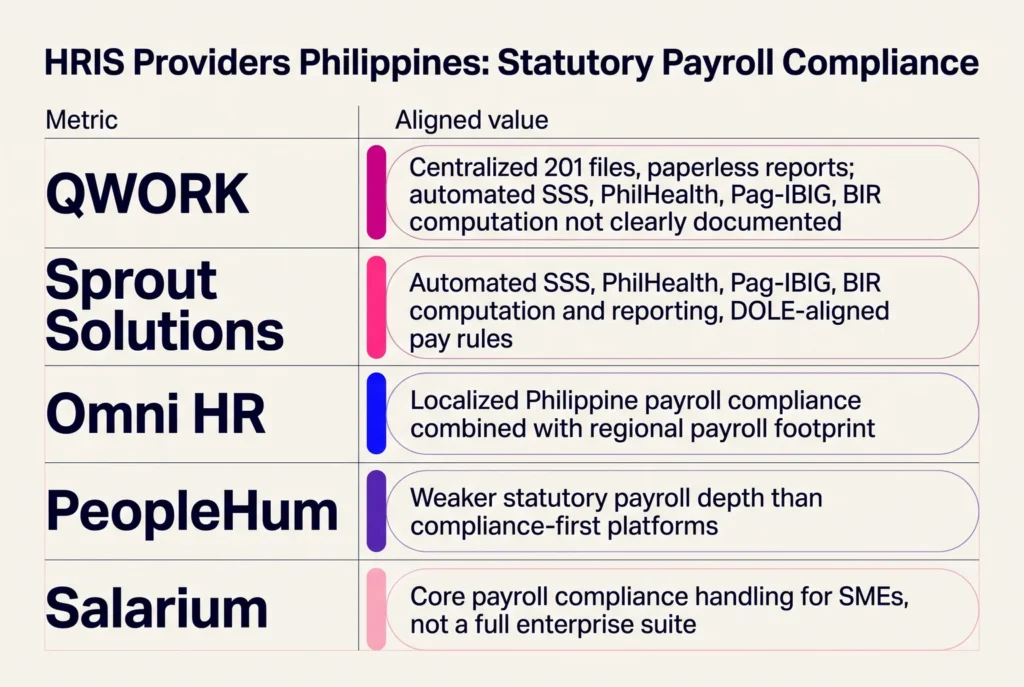
Differences between HRIS providers in the Philippines mostly come down to payroll automation depth, attendance tooling, and the business size each platform was built for. The table below lines up several options for reference, not as a ranking. For more on what “local fit” means, see this breakdown of HRIS in the Philippines.
| Provider | Statutory compliance depth | Attendance/timekeeping | Best fit | Notable gap |
|---|---|---|---|---|
| QWORK | Centralized 201 files and paperless reports feeding payroll prep; automated SSS/PhilHealth/Pag-IBIG/BIR computation isn’t clearly documented in public materials | Cloud-based attendance, digital approvals for leave and overtime | SMEs and growing mid-market companies, multi-branch teams | Confirm statutory automation depth directly with the vendor |
| Sprout Solutions | Automated SSS, PhilHealth, Pag-IBIG, BIR computations with government-ready reports | Geotagging/geofencing, DOLE-aligned shift and night-differential rules | Mid-to-large enterprises and BPOs with complex compliance needs | Heavier system, longer setup for smaller teams |
| Omni HR | Localized PH payroll plus regional footprint, preset and custom reports | Standard tracking tied to payroll reports | Growth-stage companies wanting HR and payroll analytics | Pricing starts around $3 per employee monthly |
| PeopleHum | Not payroll-first | Basic attendance, engagement tools (pulse surveys, recognition) | Companies prioritizing engagement over payroll depth | Weaker statutory payroll than compliance-first platforms |
| Salarium | Core payroll compliance, flexible disbursement | Basic timekeeping | Budget-conscious SMEs needing the essentials | Not a full enterprise suite |
Custom, in-house systems belong in this conversation too, though most Philippine businesses lean toward vendor-provided HRIS to avoid carrying compliance and maintenance risk alone. That route only makes sense with strong internal IT and legal capacity behind it.
None of these fits every situation equally. QWORK is a Philippine-built option worth evaluating, detailed further in the QWORK Human Resource Information System overview, but the right pick depends on company size, attendance complexity, and how much payroll automation a business needs versus what it can manage in-house.
Payroll, attendance, and records: what each comparison area actually covers
A comparison table only helps if you know what sits behind each column. Four functional areas decide whether an HRIS payroll system Philippines companies adopt will hold up under actual use, not just a sales demo.
Statutory compliance depth. This is more than SSS, PhilHealth, and Pag-IBIG calculations. It includes whether the system produces BIR-ready reports tied to Form 1601-C, the monthly remittance return for withholding tax on compensation, and whether year-end totals reconcile cleanly with Form 2316, the annual certificate issued to each employee. Mismatches between monthly 1601-C filings and annual 2316 totals can trigger BIR queries, so ask vendors directly how their system supports this reconciliation, since employers are required to keep payroll records, including filed 1601-C and proof of payment, for at least ten years.
13th month pay handling. Basic 13th month computation (one-twelfth of basic salary earned) sounds simple until allowances, overtime, and night differential enter the picture. These are excluded from basic salary unless a company explicitly integrates them through policy or CBA. A system that can’t apply this distinction correctly will misstate 13th month pay for anyone with irregular hours, and it needs to handle the TRAIN law exemption on the first ₱90,000.
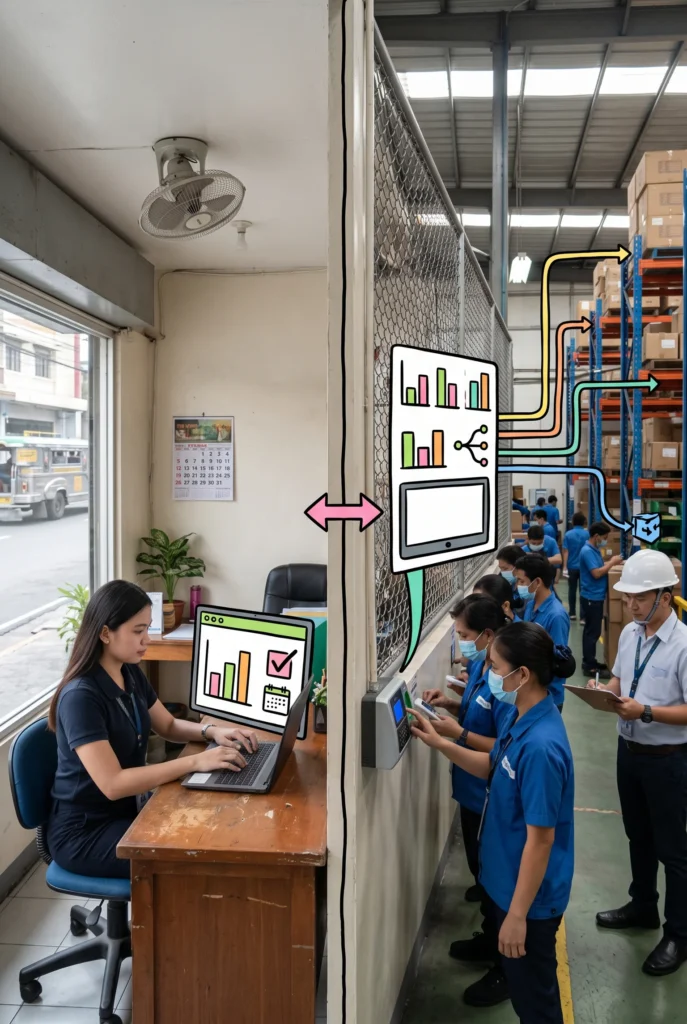
Attendance and timekeeping integration. Biometric devices, geofencing, and shift-based rules matter more for multi-branch or field teams than for single-office SMEs. The real test is whether attendance data flows into payroll prep without manual re-entry.
201 file and self-service depth. Centralized employee records and self-service requests (leave, loans, COE) reduce back-and-forth, but only if approvals route correctly and records stay audit-ready.
Weigh these against implementation effort and total cost, covered next, since a compliance-heavy system with a long rollout isn’t automatically the right fit for HR software Philippines buyers running lean teams.
Matching HRIS types to how your business actually operates
The functional areas above matter differently depending on what kind of company is buying. A single-office SME with 40 employees and a multi-branch retailer with 400 are not shopping for the same thing, even if both call it an HRIS.
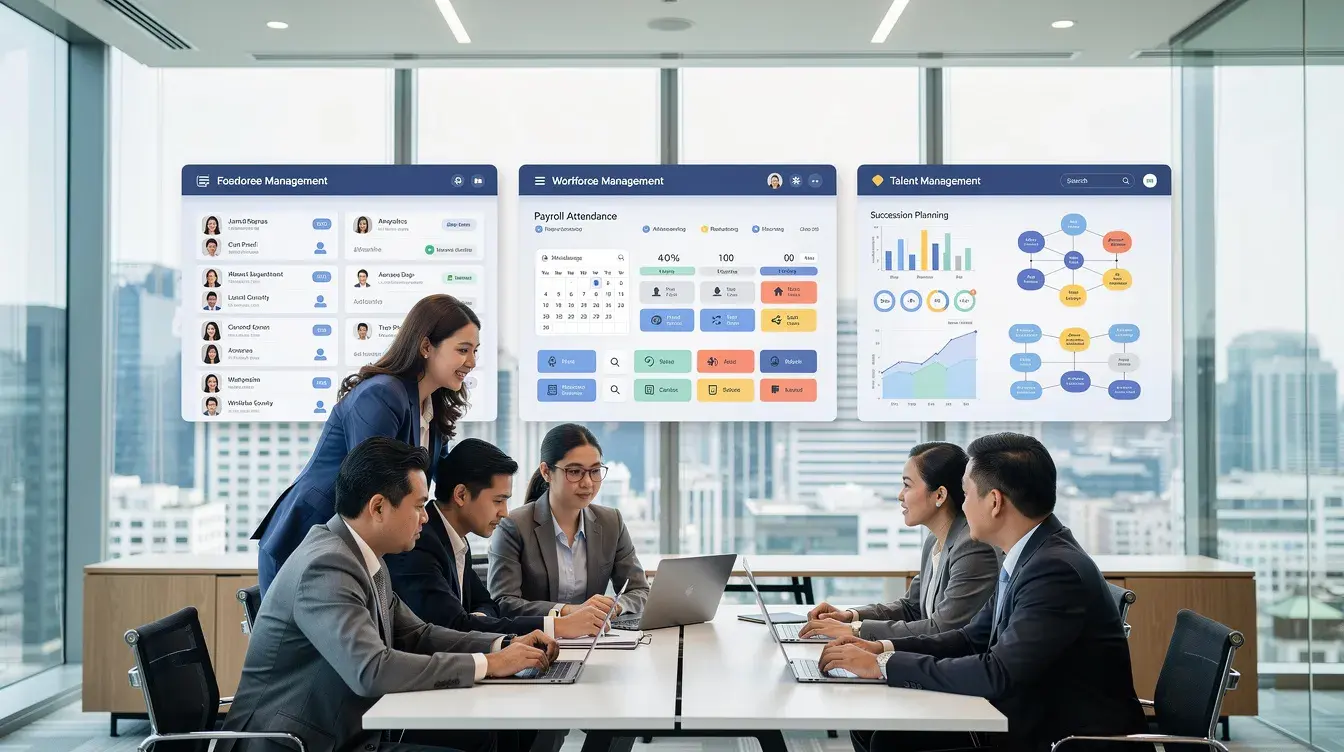
For small and growing businesses, the priority is a lean set of core modules done well: employee records, payroll, time and attendance, and leave management, before anything talent- or analytics-related. HRIS for SMEs Philippines buyers generally get more value from affordable, easy-to-use systems that automate repetitive payroll and attendance tasks than from feature-heavy platforms built for larger HR teams. If a lean HR team of one or two people needs a manual to run basic leave approval, the system is probably overbuilt for the job.
Multi-branch retailers and F&B chains face a different problem: consolidating attendance across locations into one payroll run, applying branch-level wage rates, and keeping access control manageable as headcount and locations grow. Without that consolidation, HR ends up reconciling spreadsheets from five branches by hand every cutoff.
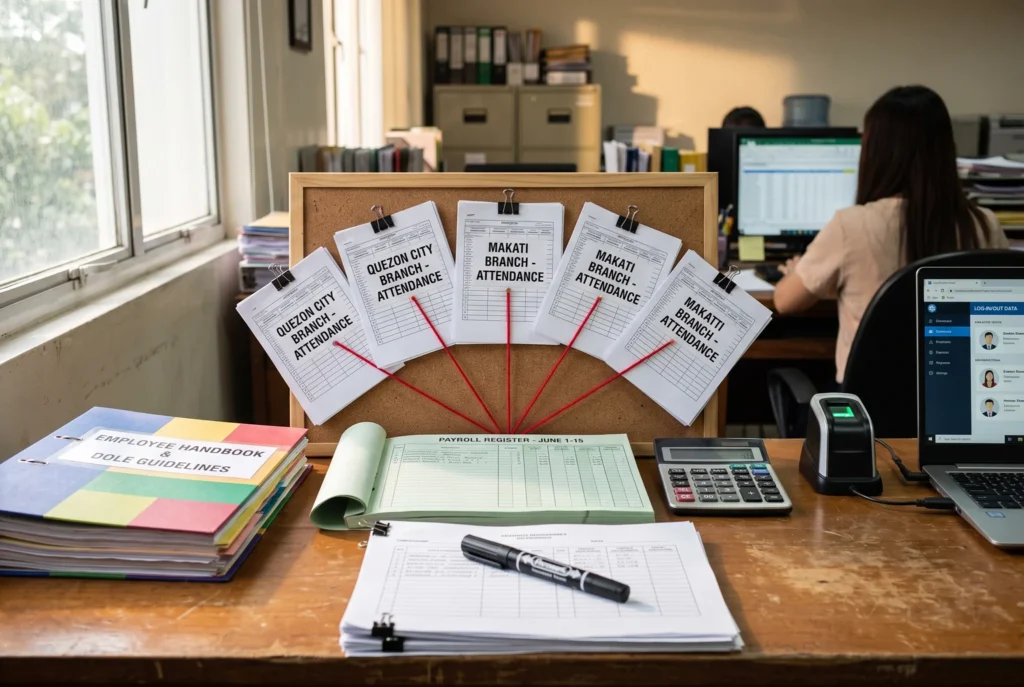
Shift-based BPO and manufacturing employers need advanced scheduling, biometric or mobile time capture, and payroll rules that correctly apply rest days, maximum hours, and premium pay under DOLE guidelines.
Companies with unusual approval chains, multiple entities, or workflows that don’t fit an off-the-shelf template are a different case again. This is where a locally built, configurable system like QWORK can be a reasonable fit, not because customization is inherently better, but because Philippine businesses with layered approval structures (property issuance, memos, offboarding tied to specific internal policy) sometimes outgrow rigid templates faster than they outgrow their headcount. That’s a narrower use case than “every business,” which is why it belongs in a category, not a headline claim.
What drives HRIS cost up or down
Most Philippine HRIS vendors price on a per-employee-per-month basis, so cost scales with headcount rather than a flat license fee. That’s the starting number, but not the full total.
Module scope moves the price next. Core HR (records, leave, attendance) sits at one tier, while payroll processing, applicant tracking, learning management, or analytics are often billed as add-ons. Attendance complexity adds another layer: a single office running fixed shifts costs less to support than a multi-branch retailer or manufacturer needing biometric devices, geofencing, and shift-differential rules across locations.
Payroll and statutory compliance depth also matters. Handling SSS, PhilHealth, Pag-IBIG, and BIR contributions correctly, including edge cases like retroactive adjustments, generally requires a more capable (and pricier) configuration than a system that only tracks basic attendance.
Then there are the costs buyers tend to underestimate: implementation and data migration, often billed separately as one-time professional services fees, especially when legacy spreadsheet data needs cleaning before it goes in; integrations with accounting or ERP systems, which may involve paid connectors or ongoing API maintenance; and employee training, which Philippine buyer guides flag as a hidden cost sitting outside the monthly subscription line. Support tier (standard versus dedicated account management) and any custom workflows or branded portals round out the picture.
None of this tells you what a specific quote will look like, but it tells you what to ask about before signing.

A checklist for vendor calls and demos
Before signing anything, run each shortlisted provider through the same set of questions. Keeping the list identical across vendors is what makes the comparison useful.
- Does the system handle SSS, PhilHealth, Pag-IBIG, and BIR withholding tax natively, including overtime, night differential, and holiday pay rules?
- How are payroll and compliance rules updated when regulations change, and what’s the turnaround time for a customer-facing fix?
- What security controls protect employee data (encryption, multi-factor authentication, role-based access, backups), and can the vendor produce an audit trail for every data sync between systems, not just a summary log?
- What’s the scope of data migration, who validates the imported records, and can historical data be exported later if you switch providers?
- Can internal staff configure multi-level approval workflows without vendor involvement, and are changes to those workflows versioned and traceable?
- What reports come standard, and can HR pull audit-ready histories segmented by branch or department without paying extra?
- Which integrations are native versus custom-built, and what does a custom integration cost in time and money?
- Who leads implementation, what’s the typical go-live timeline, and what support channels and response times are guaranteed?
- Can the vendor provide reference clients of similar size operating in the Philippines?

Vendors who answer these plainly, without redirecting to a sales deck, are usually the ones worth a second call.
Matching the system to the problem, not the other way around
The checklist above works for any vendor because it tests for the same thing every time: whether a system reduces your operational complexity or just moves it somewhere else. A very small business with outsourced payroll mainly needs a lightweight, core HRIS for records and basic workflows. An SME with standard statutory deductions and one or two pay schemes usually does better with an integrated HRIS that handles full payroll in one place. A company facing complex, frequently changing rules, multiple pay structures, or heavy audit exposure often needs an HRIS paired with a specialist payroll or compliance engine, since generic payroll modules in a standard HRIS can be too limited for that risk level. Larger or fast-scaling organizations tend to need a highly configurable platform, sometimes closer to a full HCM suite, built for deep customization across the employee lifecycle, though implementations there commonly run six to eighteen months.
None of these categories is objectively “best.” Each is a fit for a specific complexity profile, which is what the next section uses to place QWORK.
Where QWORK fits
QWORK is built specifically for Philippine HR needs: digital 201 files, attendance and leave tracking that feeds into payroll preparation, and reporting aligned to SSS, PhilHealth, and Pag-IBIG requirements. Its approval workflows for leave, overtime, loans, and COE requests are configurable rather than fixed, which suits companies with more than one branch or employee type. Implementation support, including pre-implementation review and role-based training, matters most to teams without a dedicated HR systems administrator.
That combination makes QWORK a reasonable fit for SMEs and mid-market companies in the Philippines that want compliance-aware records and workflow automation without adopting a full-scale HCM suite. Larger enterprises with highly complex payroll rules should still weigh it against specialist alternatives.