


The cost of running separate systems for one supply chain
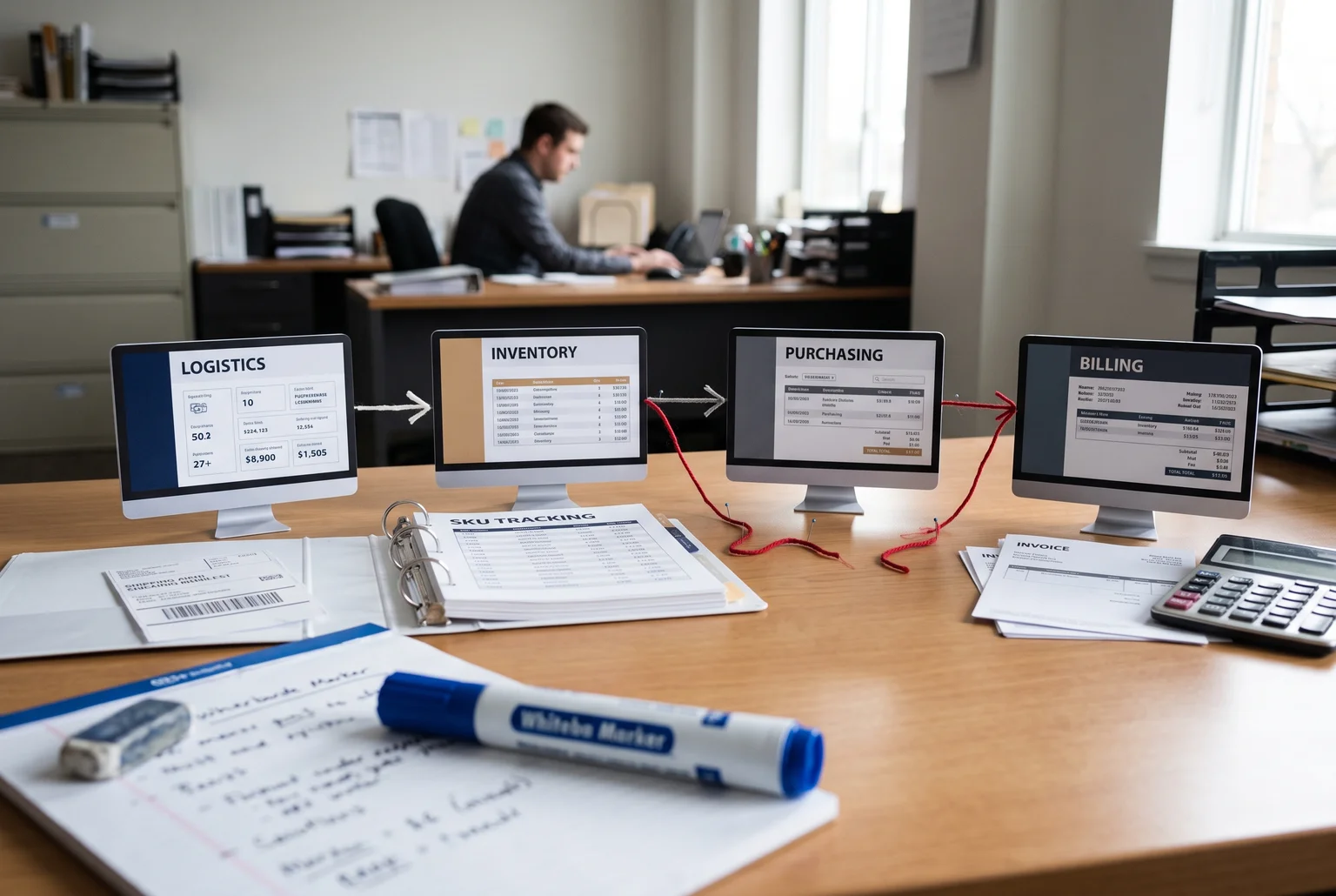
Many trading and logistics businesses in the Philippines run logistics, inventory, purchasing, and billing as separate tools that don’t talk to each other. A warehouse team tracks stock in one system, purchasing raises orders in another, logistics coordinates deliveries somewhere else, and billing reconciles everything after the fact, often manually.
When these systems are maintained separately, staff typically need to reconcile figures by hand and lack a timely, unified view of what’s actually happening across operations. A purchase order might not reflect a warehouse’s actual stock position. A delivery delay might not reach billing until a customer complains. Siloed information like this can create real operational risks: delayed follow-up, slower decisions, stock shortages, and limited financial visibility.
The Philippine Department of Trade and Industry points to interoperable logistics systems as a way to cut logistics costs and improve transparency, a signal that connected systems, not isolated ones, are where efficiency gains come from. That’s the case for looking at logistics, inventory, purchasing, and billing as one platform instead of four disconnected tools.
Bringing shipments, deliveries, and warehouses into one view
QAlpha’s Logistics Management System is built around four core capabilities: shipment tracking, delivery scheduling, warehouse coordination, and transport monitoring. Together, they give trading and logistics businesses a single place to see what’s moving, where it is, and what’s next.
Shipment tracking covers products from order placement through final delivery, so staff aren’t calling drivers or checking multiple logs to answer a customer’s “where is it” question.
Delivery scheduling and transport monitoring sit inside the same platform, which means dispatch decisions and en route status updates don’t live in separate spreadsheets or messaging threads.
Warehouse coordination connects what’s happening on the warehouse floor to downstream transport and delivery, so a delay in picking or loading shows up in the same system that’s tracking the truck.
Quadrant Alpha’s materials also describe centralized visibility into delivery statuses, distinguishing pending, delayed, and completed deliveries, along with support for assigning vehicles and drivers to routes based on resource availability, as detailed on the company’s logistics software page.

The result is a logistics module built to answer the delay-and-blind-spot problem directly, not just track trucks in isolation.
Keeping stock counts honest across every warehouse and branch
QAlpha’s Inventory Management System centers on one problem: knowing what stock actually exists, and where, once a business runs more than one warehouse, commissary, or branch.
Multi-location visibility gives staff centralized control over stock across all sites instead of managing each location’s numbers separately.
Barcode-enabled receiving and delivery records stock movements as they happen, updating quantities automatically rather than relying on manual tallies. This makes it easier to spot a discrepancy between what was recorded and what’s physically on the shelf, since every movement has a barcode scan behind it.
Condition-based tracking flags damaged, spoiled, and expired products separately from sellable stock, which matters for businesses handling perishables or fragile goods across branches.
Pilferage control is listed as a core capability, though the product page doesn’t spell out the specific mechanism, whether that’s user permissions, cycle counts, or approval steps.
Supplier price management and configurable stock thresholds per SKU and warehouse round out the system, letting teams flag replenishment needs at the specific location running low rather than guessing from company-wide totals.

Turning purchase requests into a tracked, approved process
Where inventory tells a business what it has, QAlpha’s Purchasing Management System governs how new stock gets requested and bought in the first place, replacing manual coordination and scattered records with a centralized purchasing workflow.
Requests move through policy-based approval flows, with staff submitting requests electronically instead of routing paper forms or chasing sign-offs through email.
Once approved, procurement staff can issue requests for quotation to suppliers kept in a maintained supplier database, with supplier details and pricing on hand to support comparison and selection.
The system digitally creates and stores purchase orders, tracking each one from issuance through delivery so staff can see where an order sits without calling the supplier directly.
Supplier records connect to purchasing transactions, giving teams a view of supplier activity over time, and the workflow covers supplier returns alongside general monitoring of requisitions and purchases.
Purchasing can also link to receiving and accounts payable, tying costs, receipts, and supplier records together rather than leaving finance to reconcile them separately after the fact.

Closing the loop on invoicing, payments, and sales visibility
Purchasing and inventory tell a business what it owns and owes suppliers. QAlpha’s Billing and Sales Management System covers the other side of the ledger: what customers owe the business and how much is actually coming in.
The system centralizes billing and invoicing, generating billing per customer instead of leaving staff to assemble invoices manually. Invoices can include credit terms and discounts, and the system calculates sales tax and produces receipts once payments are recorded.
On collections, it tracks invoices and amounts due through alerts and automated billing notifications, so overdue accounts don’t just sit unnoticed until someone happens to check. Payments get logged with receipts and payment reports, giving finance teams a clearer view of what’s been collected versus what’s still outstanding.
Quadrant Alpha describes this as connecting transaction processing, collections monitoring, and sales reporting in one workflow, with automated reporting supporting review of sales and receivables performance. The company also points to real-time visibility into sales and receivables, letting teams monitor revenue and sales transactions rather than reconstructing them at month-end.
For trading businesses juggling multiple customers and payment terms, that combination of invoicing, receivables tracking, and reporting in one place replaces a common blind spot: knowing sales moved, but not knowing, in the moment, who still owes what.

Connecting procurement, stock, delivery, and cash flow into one picture
Looked at separately, the four systems solve four separate problems. Looked at together, they describe one supply chain moving through a business: a purchase gets approved, stock arrives and gets counted, a shipment goes out, a customer gets billed. Quadrant Alpha frames its broader solutions portfolio around this idea, positioning inventory, purchasing, logistics, and sales as connected parts of a single operational picture rather than tools that happen to sit on the same company’s server.
The practical link points start where each module’s data would naturally feed the next. Purchasing transactions captured in the Purchasing Management System integrate with receiving and accounts payable activity, which is also where new stock enters the inventory picture. Delivery activity tracked through logistics is described as updating stock levels in real time, so warehouse staff and sales teams are working from the same inventory figures instead of reconciling two different counts at the end of the week. From there, billing and sales draws on that same stock and transaction history to generate invoices and track receivables.
None of the confirmed material describes a specific technical mechanism, like a shared database or an API layer, that ties the four systems together. What’s documented is the operational flow: procurement to receiving to delivery to invoicing, described across Quadrant Alpha’s supply chain messaging as an end-to-end sequence rather than four disconnected handoffs.

For a trading business, that sequence is the whole point. A stockout, a missed delivery window, and an overdue invoice are usually the same underlying event seen from three different desks. Connecting the data those desks work from is what turns three separate fire drills into one visible problem.
The businesses that gain the most from connecting all four systems
Quadrant Alpha names retail, manufacturing, logistics and trading, food and beverage, and government among the industries it serves, and the pattern across those groups is a business coordinating procurement, warehousing, delivery, and sales across more than one location or branch. That description covers distributors, importers, wholesalers, and trading companies where purchasing, warehousing, and delivery are handled by separate teams rather than one person tracking everything by hand.
Retail chains fit this profile directly, with reported client examples including Gaisano Malls Davao and Cebu and Doctor Leather. Manufacturers managing large inventories and recurring purchase orders are another named use case, as are food and beverage operators running repeat procurement across multiple branches. Government suppliers and contractors, who need structured purchasing and delivery records for compliance, round out the list.
The common thread isn’t company size. It’s whether procurement, stock, delivery, and billing already touch more than one team or site.
Requesting a walkthrough of the connected platform
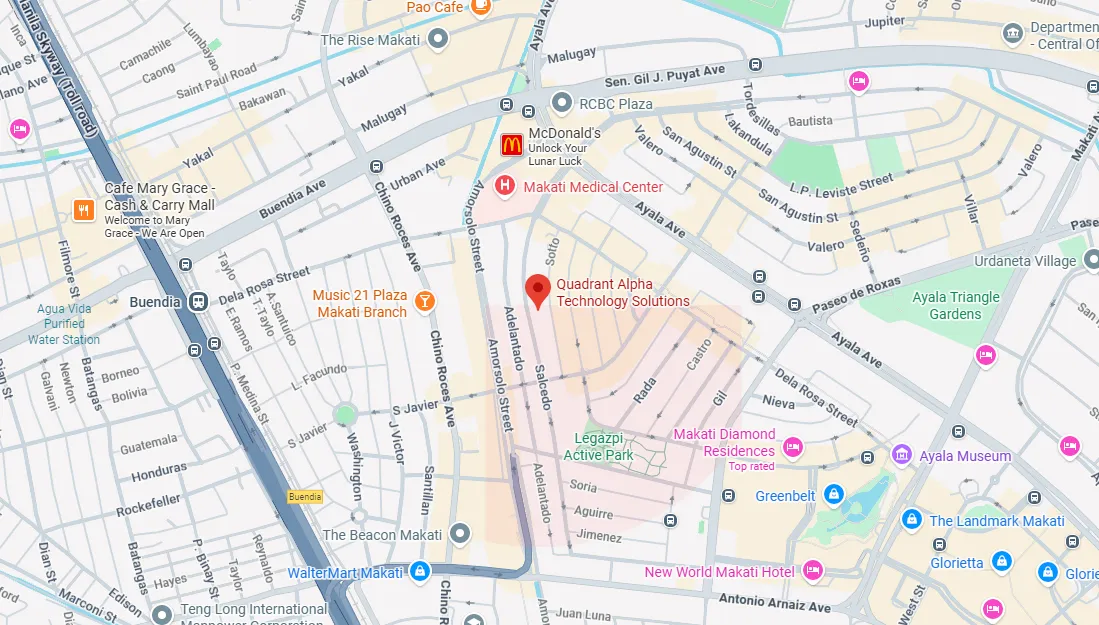
Quadrant Alpha, based in Makati, builds its logistics, inventory, purchasing, and billing and sales systems as one platform rather than four separate products, and prospects can request a demo directly through its website. The company frames itself as a custom software partner rather than an off-the-shelf vendor, backing implementations with a dedicated support team.
If disconnected tools are already costing your team stock accuracy, delivery visibility, or billing accuracy, reach out to Quadrant Alpha at 178 Salcedo Street, Legaspi Village, Makati City, or through +632 8813-7616, and ask what a connected logistics, inventory, purchasing, and billing setup would look like for your business.