


What fragmented supply chains actually cost restaurant operators
Inventory recording errors in the Philippine food and beverage industry can quietly drain thousands of pesos a month, according to ANSI Information Systems, and the same research points to a wider pattern: 40% of food waste in the country happens in customer-facing businesses like restaurants, supermarkets, and hotels. For a multi-branch operator, that waste rarely comes from one big mistake. It comes from a commissary that doesn’t know what a branch already has, a purchasing team ordering off yesterday’s numbers, and a walk-in freezer nobody checked before the delivery truck arrived.
Logistics adds its own pressure. Temperature-controlled shipping in the Philippines runs 15 to 25 percent more than ambient transport, per Ken Research, and every emergency run to cover a stockout eats into that margin twice: once for the rush freight, once for the spoiled stock sitting unused at another branch. Multiply this across ten, twenty, or fifty locations, and the losses stop looking like isolated incidents and start looking like a structural cost of doing business.
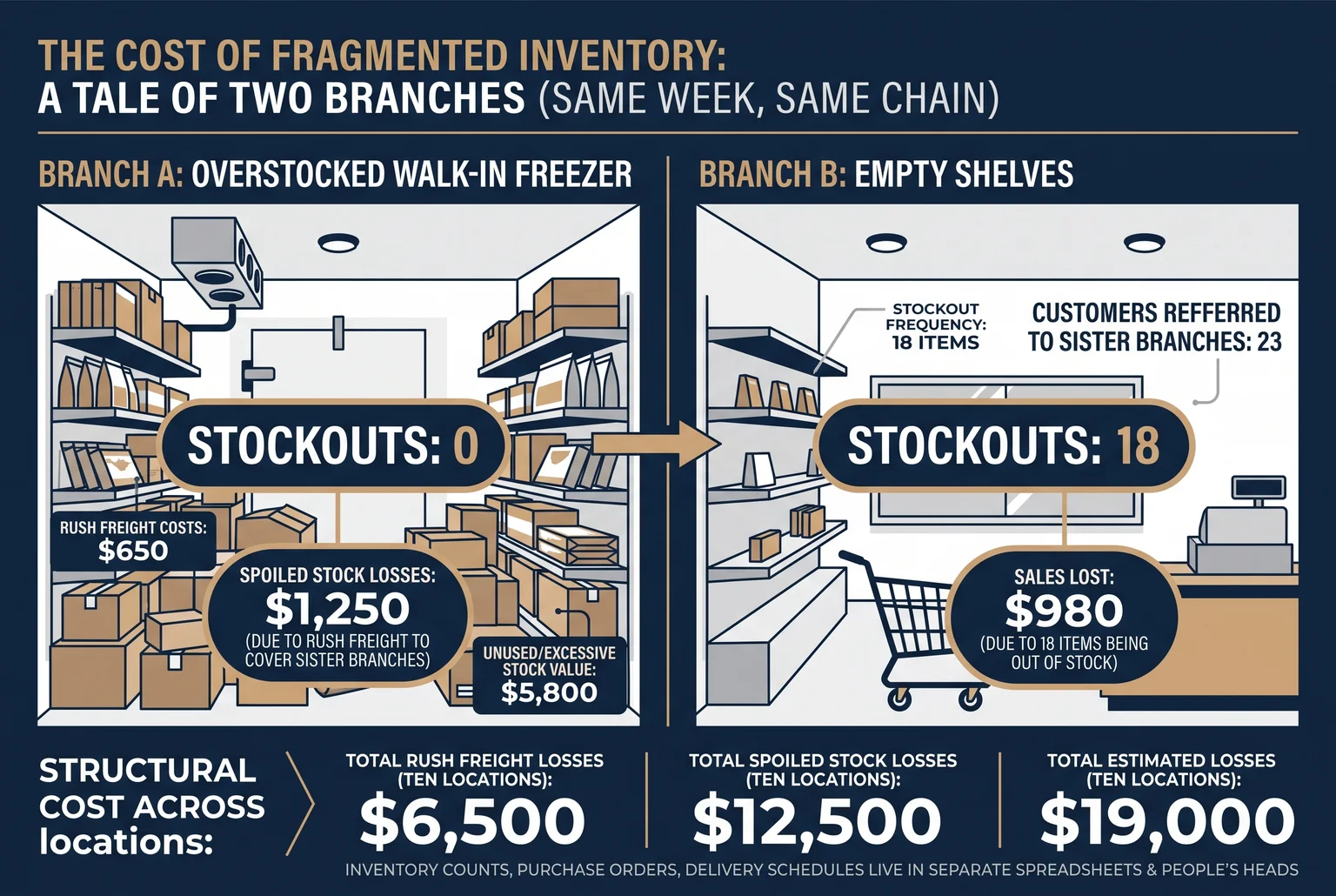
None of this happens because staff are careless. It happens because inventory counts, purchase orders, and delivery schedules live in separate spreadsheets, separate messaging threads, and separate people’s heads. Without one shared source of truth across branches and the commissary, owners are left guessing at what they actually have, what they actually need, and what it’s actually costing them to move product from one to the other.
Where the losses actually happen
Multi-branch and commissary-based F&B operations run into the same handful of problems, no matter the cuisine or price point:
- Spoilage from poor rotation and forecasting. Over-ordering, weak FIFO or FEFO rotation, and demand guesses based on gut feel rather than data are common causes of food waste, often traced to a commissary that has no real visibility into what branches are actually using.
- Pilferage and unexplained shrinkage. Theft, unrecorded staff consumption, receiving discrepancies, and portioning errors all show up as shrinkage, and weak reconciliation between purchasing, stock movement, and sales makes it hard to tell which is which.
- Stockouts that stall service. Running out of a key ingredient mid-shift forces menu substitutions or emergency purchasing, both of which hit consistency and customer satisfaction.
- Manual purchasing errors. Paper or spreadsheet-based purchase records are prone to loss, duplication, and inaccurate entry, which slows down reordering and produces numbers nobody fully trusts.
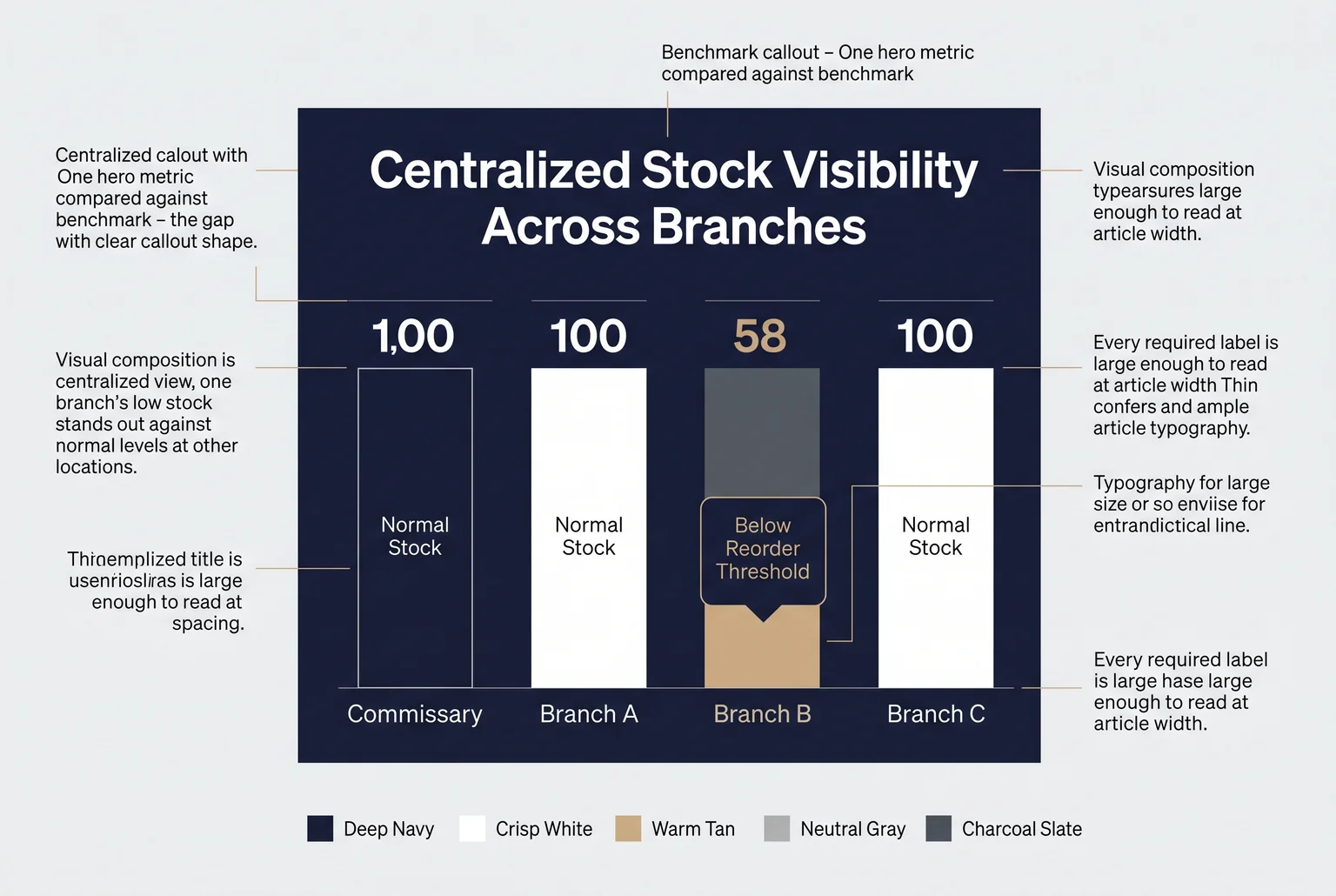
- Visibility gaps across branches. Inaccurate records can make a branch look adequately stocked when usable stock is actually far lower, and late or inconsistent recording of transfers between commissary and branches erodes traceability the moment more than one location is involved.
Each of these problems compounds the others. A branch that looks stocked on paper won’t get resupplied, then runs out mid-service, then places a rush order that arrives too late or in the wrong quantity.
A checklist for evaluating restaurant inventory software
Before signing up for any platform, restaurant operators should measure it against a short list of requirements built for how Philippine F&B businesses actually run.
Real-time, multi-location visibility. The system should show stock levels across every branch, warehouse, and commissary at once, with location-specific reorder controls and transfer tracking, not a report someone has to compile at the end of the day.
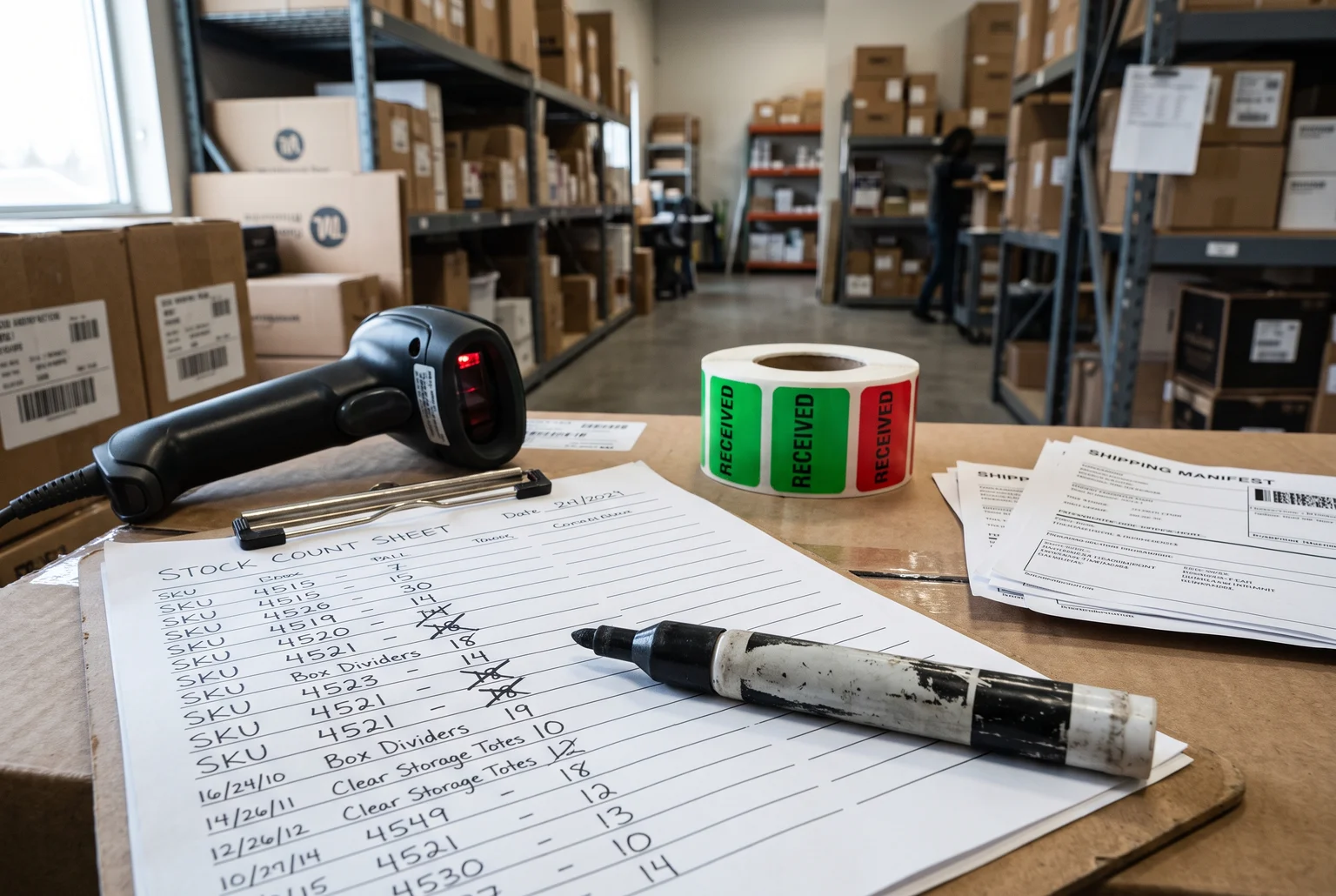
Barcode-enabled receiving and movement. Scanning stock in and out at receiving, transfer, and count reduces manual entry errors and makes it possible to trace damaged or missing goods back to a specific point.
Separate tracking for waste, spoilage, and shrinkage. These are different problems with different causes, and the software should report them separately by item and location instead of lumping everything into one vague “variance” number.
Commissary and multi-warehouse workflows. Central kitchens need to record production, receiving, and finished-batch movements to branches as distinct transaction types, not manual adjustments.
Purchasing controls tied to inventory. Purchase orders, par-level alerts, and supplier price history should sit on top of the same stock data, not a disconnected spreadsheet.
Recipe-level depletion and POS integration. Ingredient usage should deduct automatically from sales, supporting theoretical-versus-actual usage comparisons that flag shrinkage early.
Audit trails and mobile usability. Approval workflows, variance reports, and mobile-friendly stocktaking matter more once a business runs more than one location.

Where the checklist meets an actual product
Quadrant Alpha’s Inventory Management System is built around the same gaps that trip up multi-branch F&B operators: no shared view of stock, no clean audit trail, no way to tell if a branch is actually running low until someone calls it in.
The system centers on barcode-enabled receiving and delivery, so goods get scanned into the record the moment they arrive at a warehouse or commissary and again when they move out to a branch. That gives every transfer a timestamp and a paper trail, instead of a signature on a delivery form that gets filed and forgotten.
Quadrant Alpha’s broader solutions page describes multi-warehouse management with centralized control, real-time tracking, and alerts, which is the piece that matters most for commissary-based operations. A central kitchen producing for ten branches needs one system showing what’s on hand at each site, not ten separate logs that someone reconciles manually at month-end. The product material doesn’t specify how fast updates propagate across locations, so operators evaluating the system should confirm sync behavior directly with Quadrant Alpha rather than assume instant updates for every transaction.
A case study on Quadrant Alpha’s site, covering an inventory, purchasing, and sales rollout for a large Philippine logistics provider, reports “satisfactory client support” and “ongoing user familiarization, especially in Inventory,” alongside steady progress on the sales side. It’s worth treating that as a vendor-reported result rather than an independently audited benchmark, but it does point to a system built to be usable by staff who aren’t inventory specialists, which matters for restaurant crews juggling prep, service, and stock counts in the same shift.
The IMS doesn’t work alone. Its receiving and transfer data feeds directly into the purchasing and logistics workflows covered next, closing the loop between what a branch has and what gets ordered or shipped to replace it.
Purchasing and logistics close the loop
Inventory data is only useful if it triggers action. That is where Quadrant Alpha’s Purchasing Management System and Logistics Management System come in, as separate products that sit on either side of the Inventory Management System rather than folding into it.
Purchasing Management centralizes procurement requests, supplier records, approvals, purchase orders, and order tracking, including RFQ approval and evaluation workflows and tracking of transaction costs and receipts through integration with receiving and accounts payable. When a branch’s stock drops toward a set threshold, that gap becomes a purchase request routed to a supplier with a documented price history, not a phone call to whichever vendor picked up first.
Logistics Management picks up from there, coordinating movement from order placement through final delivery. It covers warehouse coordination, transport monitoring, route planning, and shipment tracking, along with communication among delivery stakeholders, so a commissary can schedule and confirm deliveries to ten branches without relying on group chats and delivery-guy phone calls.
Each system keeps its own scope. Inventory Management records what is on hand and where. Purchasing Management handles who to order from and on what terms. Logistics Management gets the order there. Quadrant Alpha’s solutions page presents all three as parts of one connected operation, not standalone tools bolted together after the fact.

A fourth system, kept out of this discussion
Quadrant Alpha also offers a Billing and Sales Management System, and it is worth naming so this post doesn’t misrepresent the full lineup. It handles invoicing, payments due, batch payments, credit management, refunds, and billing that accounts for taxes, discounts, and credit terms.
None of that is inventory control or physical supply-chain coordination. It sits downstream of a sale, not upstream in stock, procurement, or delivery. For a restaurant group evaluating supply chain software specifically, Billing and Sales Management belongs in a separate conversation about receivables and sales transactions, not this one. Quadrant Alpha’s own solutions page lists it as a distinct offering alongside Inventory, Purchasing, and Logistics Management, not a component of any of them.
One system, one view of the business
Inventory, Purchasing, and Logistics Management work as one connected system for Philippine F&B operators: stock levels trigger purchase orders, purchase orders confirm supplier deliveries, and logistics gets that stock from commissary to branch, all visible from one dashboard instead of three disconnected tools and a group chat.
For a multi-branch or commissary-based operation, that’s the difference between finding out about a stockout when a branch calls in a panic and catching it before it happens.
If your restaurant group is still stitching together spreadsheets, SMS orders, and delivery guesswork, it’s worth seeing how this works in practice. Quadrant Alpha’s Request a Demo page is the fastest way to get a walkthrough tailored to your branch count and commissary setup. You can also reach the team directly at +632 8813-7616 or by email to talk through your specific supply chain setup before committing to anything.