



Employers as the BIR’s first line of tax collection
Every business that pays employees in the Philippines is also, by law, a tax collector. Under the National Internal Revenue Code, employers act as withholding agents on compensation income, computing and deducting income tax from every payroll run and remitting it to the Bureau of Internal Revenue on the employer’s behalf, not the employee’s. This duty was reinforced by Revenue Regulations No. 11-2018, which the BIR issued to align withholding rules with the changes introduced under the TRAIN Law.
For an HR or payroll team, this means withholding tax isn’t a once-a-year concern handled at filing season. It’s a recurring obligation tied to every cutoff, every new hire, and every adjustment to pay. Get the computation wrong, miss a remittance deadline, or misclassify a payment, and the business, not the employee, carries the compliance risk.
This guide walks through how withholding tax on compensation works in practice, where employers commonly go wrong, and how payroll software reduces the manual work and risk involved in staying compliant.

How withholding on compensation actually works
Any business with employees on payroll is required to withhold income tax from compensation before it reaches the employee, and to remit that amount to the BIR. This applies whether the worker is rank-and-file or managerial, and regardless of company size. The tax withheld is computed under a graduated schedule for compensation income, revised by the TRAIN Law (RA 10963) and its implementing rules, Revenue Regulations No. 11-2018. One notable change under TRAIN was the addition of a lower tier for minimum wage and low-income earners, who owe little or no withholding tax depending on how much they earn. The exact bracket figures sit in RR 11-2018 itself, and employers should check the current version on bir.gov.ph rather than rely on older payroll templates that may still reflect pre-TRAIN rates.
Once tax is withheld, two forms carry the paper trail. BIR Form 1601-C is the monthly remittance return: it reports how much was withheld from employees’ pay during a given month and accompanies the actual payment to the BIR. The standard deadline falls on the 10th day of the month following the withholding, except for December, when employers get until January 25 of the following year. Businesses classified as large taxpayers follow a slightly different clock, filing and paying by the 25th of the following month.

BIR Form 2316 works differently. It’s an annual certificate, not a monthly filing, summarizing everything an employee earned and everything withheld from them over the year. Employers issue it to each employee, typically by January 31 of the following year, and it doubles as the employee’s proof of income and tax paid when they file (or qualify for substituted filing of) their own annual return.
Together, 1601-C and 2316 form the backbone of compensation withholding compliance: one is the employer’s monthly conversation with the BIR, the other is the employer’s yearly accounting to the employee.
Where employers usually go wrong
Most withholding tax problems trace back to a small number of recurring mistakes rather than deliberate evasion. Payroll teams often keep using outdated tax tables after a regulation update, miscompute annualized tax at year-end, or misclassify pay items such as overtime, holiday, or night differential pay, all of which change how much should be withheld and remitted, as noted in common payroll error breakdowns. Incomplete employee records, like missing or incorrect TINs and employment dates, create mismatches between payroll registers and BIR alpha lists, which can flag a company for review.
Late filing or late remittance carries real consequences under the National Internal Revenue Code: a surcharge for failing to file or pay on time, a steeper surcharge for willful neglect or fraudulent filing, plus interest that accrues from the due date until the tax is fully paid. Sources differ on the exact current interest rate, so employers should confirm the applicable figure directly with the BIR rather than rely on older references. On top of surcharge and interest, the BIR may also assess a compromise penalty, an amount that varies by violation and is set administratively rather than fixed in a single published table.
None of this requires an audit to become expensive. A single missed remittance deadline, if it recurs across a few months, compounds surcharge, interest, and penalty on each occurrence.
The math behind spreadsheet payroll
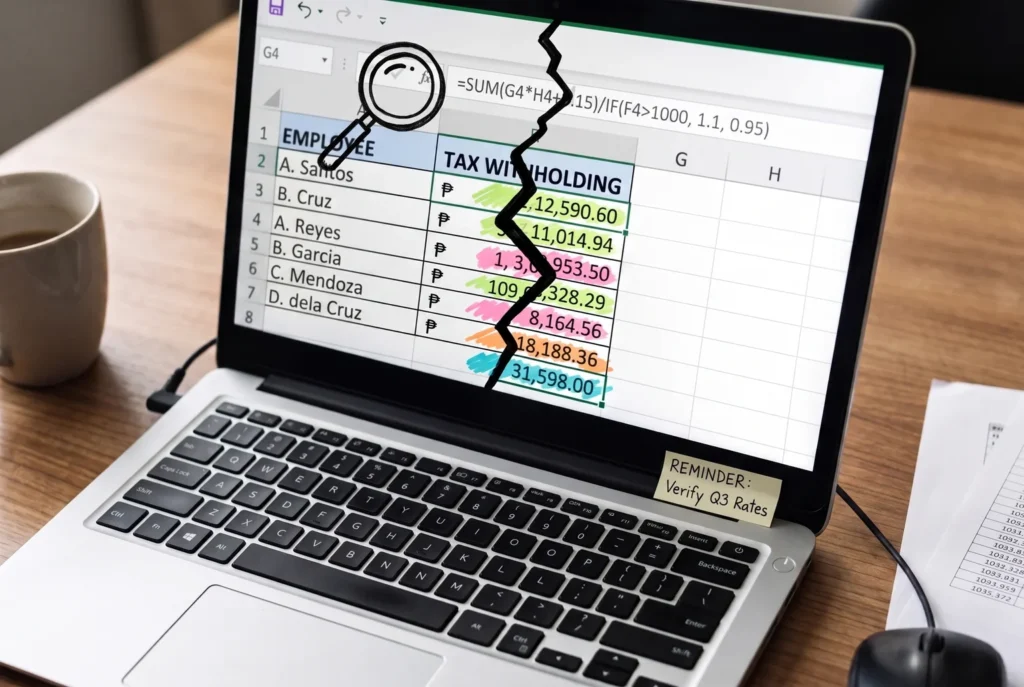
The pitfalls above rarely start as deliberate rule-breaking. They start as a formula error, a missed update, or a row that got overwritten. This is a structural problem with manual computation itself, not a training issue.
Spreadsheets have a documented error problem. Research cited by industry analysts puts the figure at roughly 90% of spreadsheets with 150 or more rows containing errors, and a separate review found errors in 91% of a smaller sample of spreadsheets examined. Payroll specifically carries its own error rate, with some estimates putting it at one in five payrolls containing mistakes.
Part of the problem is access, not just arithmetic. Shared spreadsheets with multiple editors create version control issues where a single changed formula can distort an entire payroll run without anyone noticing until the numbers land in an employee’s payslip, or worse, in a BIR filing.
What automation actually replaces in the payroll process
Payroll software does not eliminate withholding tax rules, it applies them consistently every cutoff without someone re-entering the same computation by hand. The mechanics are fairly ordinary once you see them laid out.
Attendance and time data feed directly into payroll instead of getting retyped from a separate log. A timekeeping module tracks scheduled versus actual shifts, overtime, and leave, then passes that data into payroll calculations so hours worked and hours paid match without a manual reconciliation step. Quadrant Alpha’s Qwork timekeeping and payroll system works this way: attendance records flow into pay computation instead of sitting in a separate spreadsheet someone has to copy over.
On the compensation side, the software applies rules to distinguish taxable pay from non-taxable items before running the withholding computation, rather than relying on a payroll officer remembering which allowances qualify for exclusion. This matters because misclassification is one of the more common sources of under- or over-withholding described in the earlier section on employer pitfalls.

For reporting, the system generates records that can be saved, searched, and exported to CSV rather than reconstructed from paper files each month. That export capability is meant for feeding remittance schedules and year-end reporting workflows, cutting down the retyping that creates version-control errors in shared spreadsheets. Because employee records, approvals, and payroll live in one system, an HRIS like Qwork’s HR information system also keeps the underlying employee data (hire dates, pay adjustments, loan and leave approvals) tied to the same record used for tax computation, instead of scattered across separate files. For employers weighing whether to move off manual processes altogether, a broader look at HRIS options in the Philippines is a reasonable starting point before comparing specific vendors.
None of this removes the employer’s responsibility to verify rates and filing deadlines against BIR issuances directly. Software handles repetition and consistency, not legal interpretation.
Evaluation criteria for a compliant payroll system
Whatever vendor you consider, a few features matter more than the rest of the feature list.
The system should compute withholding tax using the current graduated structure with proper annualization, and update those computations automatically when BIR issues new guidance, rather than waiting on a manual patch from your provider. The same applies to SSS, PhilHealth, and Pag-IBIG contribution tables, which change periodically and should stay current without HR having to reconfigure rate settings by hand.
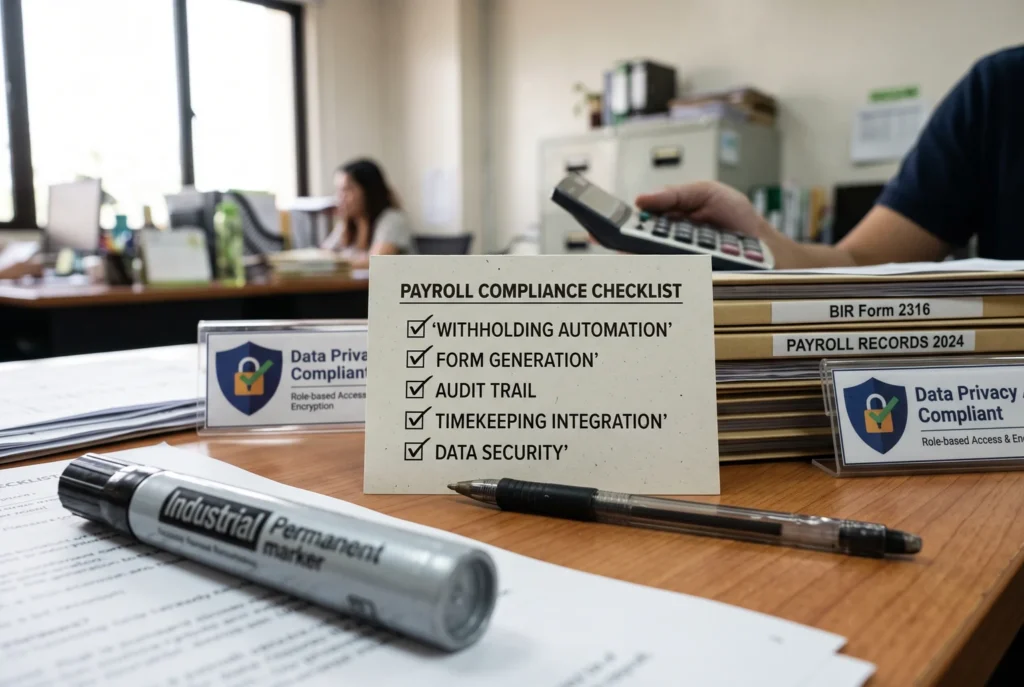
Check that the software generates the actual forms you need to file, including 1601-C, 2316, and the year-end alphalist, in formats accepted by eFPS or eBIRForms. A system that only produces a generic report you have to reformat is not saving much time.
Look for audit features: maker-checker approval workflows, change logs, and flags for unusual net-pay variances. These give you something to point to if BIR or an employee questions a computation.
Integration matters too. Timekeeping data should feed payroll directly, since overtime, holiday pay, and 13th-month computations depend on accurate attendance records. And because payroll touches personal data, confirm the vendor supports role-based access and encryption consistent with the Data Privacy Act.
Finally, ask about local support. A vendor slow to implement a new BIR circular puts the compliance burden right back on you.
Keeping withholding tax manageable over time
The obligations stay the same month to month: withhold correctly, file 1601-C on time, issue 2316 to employees, and keep records that hold up if BIR asks questions. What changes is how much of that burden falls on HR versus the system doing the computing.
If you’re currently managing this through spreadsheets and manual lookups, it’s worth checking whether a platform built for Philippine payroll rules, like Qwork’s timekeeping and payroll system, fits your setup. For employers looking at the bigger HR picture, the Qwork HRIS and broader HRIS options in the Philippines are worth comparing before you commit to a direction.