


Why fixed-spec software projects drift from how your business works
A distributor signs off a 60-page specification in January. The build runs for most of the year. By the time the software is ready, two branches have changed how they count stock, a new sales channel exists, and the people who wrote the spec have moved to other roles. The software matches the document. It does not match the business.
This guide follows one illustrative example: a mid-sized Philippine retailer-distributor that needs an inventory and sales tracking tool across several branches. It is a composite, not a real client.
Project data points to the same risk. Standish defines a failed project as one cancelled or never used. Its CHAOS Report 2015 put Agile success at 39% against 11% for Waterfall, with failure at 9% and 29%. Treat that as a signal only, since the sample and method classification are not fully transparent. PMI’s 2023 Pulse of the Profession reports 5.2% of investment wasted on poor project performance globally.
Agile development builds in short cycles and shows working software to stakeholders along the way. The guide covers what that means, how it differs from Scrum and Waterfall, a backlog-to-release walkthrough, business benefits, pitfalls, and how to choose a partner.
How agile development works: short cycles, working software, regular feedback
Agile development builds software in short cycles and releases working pieces for stakeholders to review, then adjusts the plan based on what they say. The Agile Manifesto states four values: “Individuals and interactions over processes and tools”, “Working software over comprehensive documentation”, “Customer collaboration over contract negotiation” and “Responding to change over following a plan”. In business terms, it favours a tool your staff can use over a thick document, and a conversation with the people who count stock over a locked contract. Its principles add early and frequent delivery, welcoming changing requirements, and regular reflection on how the team works.
Three terms recur. Iterative delivery repeats a plan, build, test and review loop, using each round of feedback to shape the next. An increment is a usable addition to the product that stakeholders can try. A sprint is a fixed-length period in which a team turns ideas into value. The Scrum Guide sets it at one month or less, and teams commonly choose one to four weeks. Continuous delivery is separate: automated testing keeps the software ready to release, so validated changes can go live often.

Scrum, Kanban (a visual flow of work with limits on work in progress) and Extreme Programming (engineering practices such as pair programming and automated tests) are common ways to practise agile. The next section compares Scrum with agile itself.
Software engineering treats agile as a standard approach to delivery. Teams usually track work in a tool, and the choice varies: Trello suits simple visual boards, Jira adds structured planning and reporting, and Azure DevOps links work tracking to engineering and deployment. Ask a vendor how you will see progress, whichever tool they use. A purchasing management system is the kind of project where that visibility helps.
Agile is the mindset, Scrum is one way to practise it
Agile is a set of values and principles, while Scrum is one specific framework for applying them. A team can be agile without Scrum, and a team can run Scrum’s meetings without being agile. Running sprints or stand-ups alone does not make a team agile if it ignores customer feedback and does not adapt.
Scrum adds structure. The Scrum Guide 2020 defines three accountabilities (Product Owner, Scrum Master and Developers), five events (the Sprint, Sprint Planning, Daily Scrum, Sprint Review and Sprint Retrospective) and three artefacts (Product Backlog, Sprint Backlog and Increment). Kanban asks for less. It emphasises continuous flow rather than fixed-length sprints and prescribes no specific roles. Extreme Programming focuses on engineering habits such as pair programming and automated tests, and teams often combine it with Scrum or Kanban.
| Scrum | Kanban | Extreme Programming | |
|---|---|---|---|
| Rhythm | Sprints of one month or less | Continuous flow | Short iterations |
| Roles | Three defined accountabilities | None prescribed | Not the focus |
| Main concern | Planning and review cadence | Visible work and limits on work in progress | Code quality and testing |
Scrum fits a product with a steady stream of new features. Kanban fits a team handling constant support requests or small changes.
For a decision-maker, the useful move is to ask a vendor which framework they use and why: “Which framework or practices will you use, and why do they fit our product, uncertainty, compliance needs and stakeholder availability?” A credible answer explains the reasoning and shows how your staff will review working software and influence priorities. “We are Agile” does neither.
Following one low-stock alert from backlog to release
This is an illustrative scenario. A Philippine distributor with several branches asks for a low-stock alert and a physical count feature.
| Step | What happens |
|---|---|
| 1. Backlog | The owner ranks the low-stock alert first in the Product Backlog because stockouts cost sales, and physical count entry second. |
| 2. Refinement | The team adds acceptance criteria: an alert fires at the threshold, none fires above it, it shows item and quantity, and an unresolved item does not trigger duplicates. |
| 3. Sprint Planning | The Sprint Goal is to identify low-stock items and record a physical count. |
| 4. Sprint, weeks 1 to 2 | Developers build against realistic branch data, so the first demo uses numbers staff recognise. |
| 5. Mid-sprint demo | Branch managers see the alert working. |
| 6. Feedback | Each branch owns its own stock and reorder decisions. A company-wide alert would bury managers in other branches’ items. |
| 7. Backlog change | The requirement becomes branch-scoped alerts with a head-office filter. The Product Owner reorders the backlog. |
| 8. Retrospective | Early access to branch data worked. A conversation about branch rules was missed. The action is to add permissions and filtering work. |
| 9. Release | Only work that meets the definition of Done ships: branch alerts, physical count entry, variance display and basic audit information. |
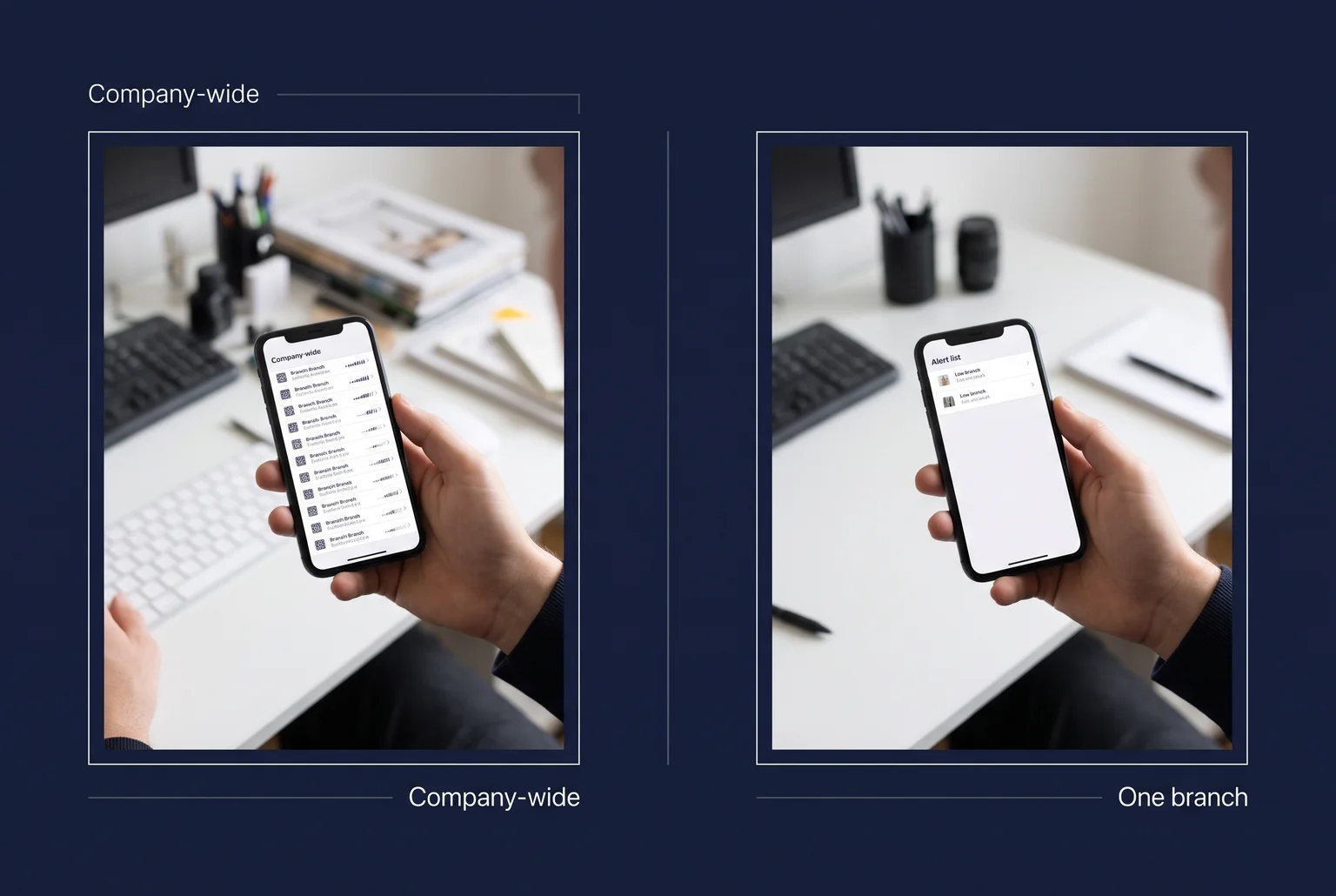
A fixed specification would have written “company-wide alert” in month one and delivered it months later, after the branches had found it unusable. Here the mistake surfaced mid-sprint and cost a revised backlog item instead of a rebuild.
The Scrum Guide’s timeboxes cap planning, review and retrospective at 8, 4 and 3 hours for a one-month Sprint, and less for a two-week one.
What agile delivers for SMEs and enterprises
The branch-alert example shows where the business value sits. Each benefit below answers a question a buyer usually asks before signing.
Earlier working software. Branch managers saw a working alert in week one or two, not at the end of a long build. For a decision-maker, that means a usable feature before the full budget is spent.
Lower risk of building the wrong thing. The company-wide alert was corrected mid-sprint for the cost of one backlog item. Almost 60% of respondents in the 17th State of Agile Report said Agile improved collaboration, and 57% reported better alignment between software delivery and business needs.
Budget that follows priorities. When the Product Owner reordered the backlog, money moved to permissions and filtering instead of a feature nobody wanted.
Stakeholder buy-in and quality. Managers who see the demo help shape the result. About 25% of respondents reported better-quality software.

For SMEs, the gains are tight budgets, small teams and fast learning. Digital.ai’s survey found 52% of small organisations said enterprise Agile works very or somewhat well, against 43% at larger companies.
Enterprises gain on multi-branch rollout and governance, with a catch: only 6% of respondents reported no adoption barriers, and resistance to change and weak leadership understanding persist. Payroll rules also move. SSS contributions rose to 15% of the Monthly Salary Credit in January 2025, which a short-cycle team can absorb as a backlog item.
One Philippine manufacturer reports 30% faster HR processing with our QWORK HRIS. This customer-reported result reflects that organisation’s experience; outcomes vary by implementation.
Agile vs Waterfall, and when not to use agile
Waterfall works when requirements are stable and late changes are expensive. Agile works when requirements are still being learned. PMI treats predictive, agile and hybrid approaches as points on one spectrum, and a hybrid mixes practices from both.
| Factor | Agile | Waterfall |
|---|---|---|
| Requirements | Discovered and reordered each sprint | Fixed and signed off upfront |
| Change | Handled through the backlog | Formal change control |
| Cost certainty | Fixed time and capacity, less certain scope and cost | Fixed scope and price |
| Stakeholders | Regular demos and decisions | Heavy at sign-off, lighter between |
| Governance | Gates around increments | Stage gates and documented approvals |
Agile is a poor fit when hardware or facility dependencies set the schedule, when a regulator requires sign-off on a complete specification, or when nobody on the business side can attend demos. Without feedback, sprints only produce guesses faster. In those cases a predictive or controlled hybrid approach may be safer.
Government and large-enterprise procurement often requires fixed scope and budget. A phased agile delivery can still fit: agree the budget, acceptance criteria and gates, then build each phase in short cycles.
Checklist before you choose
- Can you describe every requirement today, and will it hold for the whole project?
- Will someone with authority attend a demo every one to two weeks?
- Does a regulator or contract require a frozen specification before building starts?
- Does hardware or site readiness set the delivery order?
- Can procurement accept phases with a budget cap and acceptance criteria?
“No” on the first question and “yes” on the second and fifth point to agile. “Yes” on the third or fourth points to Waterfall or a hybrid.
Three ways agile projects go wrong, and questions to test a vendor
Fake agile. The team holds sprints, keeps a board and runs the events, but nothing usable ships. Scrum.org calls this Zombie Scrum: events and artifacts without a potentially releasable increment. Warning signs include a Sprint Review that is only a management presentation and retrospective actions that stay generic. In the distributor example, an “increment” is a low-stock alert a branch manager can open and react to, not a finished database table. Fix: require every sprint to end with something stakeholders can use.
Scope creep from an unmanaged backlog. The backlog becomes a fixed wish list, or a dumping ground. The Scrum Guide describes it as an emergent, ordered list, so each item needs a description, order and size through refinement. Fix: keep one backlog owner, tie items to the Product Goal, and swap work in only by moving something out. The branch-level alert change worked because it replaced a company-wide item rather than being added on top.
Ceremony overload. Meetings multiply and delivery slows. Audit each recurring meeting by the decision or coordination it produces, then cut attendance or frequency. Keep stand-ups to 15 minutes.
Questions to ask a development partner
- Show the last three increments that real users or business stakeholders could use. What was actually released or reviewed?
- What changed in the backlog because of stakeholder feedback?
- Who orders the backlog, and how do new requests enter it?
- Which recurring meetings could we drop, and why?
Agile development FAQ: definitions, sprints, suitability and pricing
What is agile software development?
It is an iterative way of building software in short cycles. Teams ship working increments early and adjust priorities based on feedback.
Is Agile the same as Scrum?
No. Agile is a set of values and principles, and Scrum is one framework for applying them.
What are the stages of agile development?
One model lists six phases: concept, inception, iteration, release, maintenance and retirement. Phase names vary between models, and iteration repeats a plan, build, test and review loop.
How long is a sprint?
Sprints usually run one to four weeks, and two weeks is common. Choose a length that produces a usable increment.
Is agile suitable for small businesses?
Yes, especially when budgets are tight and priorities will shift. A small team can start with one feature and review it every sprint.
How does agile pricing work in the Philippines?
Rates vary by provider. One outsourcing firm advertises development from US$35 per hour, billed per engineer monthly. Milestone payments are also common, and you should budget separately for maintenance.
Starting small and choosing a partner
Start with one small, high-value feature, name a backlog owner, and agree a feedback cadence. When comparing partners, ask how they handle requirements, demos and mid-project changes, and who owns the source code. At Quadrant Alpha, we build tailored solutions collaboratively through a six-phase process. To talk through a first feature or see a demo, explore our Custom Software Development approach.