


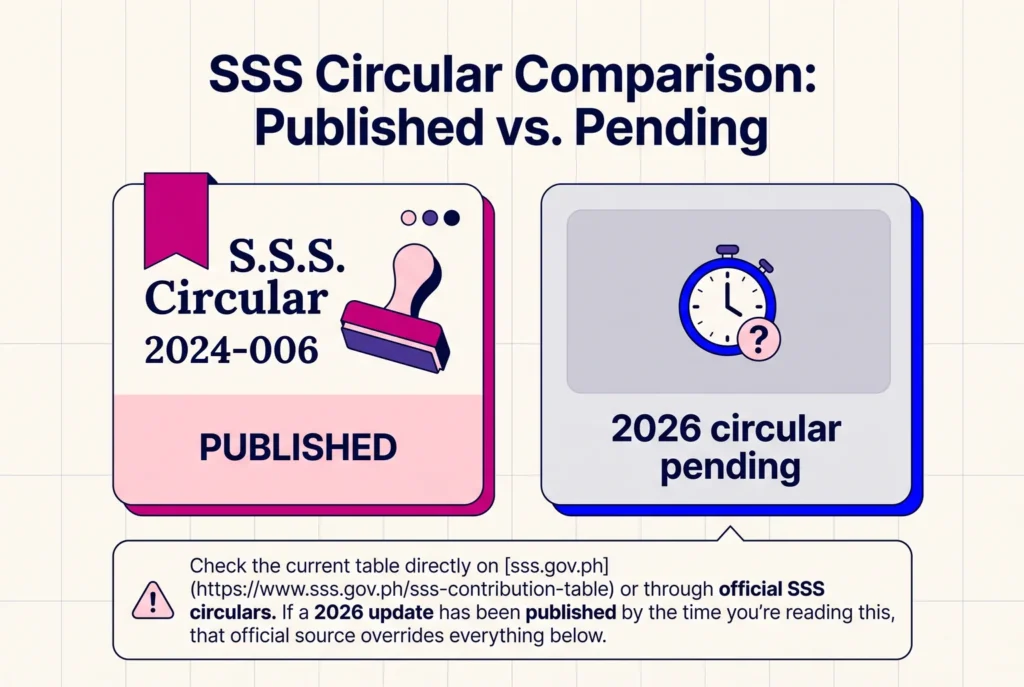
Before you apply any figures in this guide: verify first
No official SSS circular setting a distinct 2026 contribution rate or schedule exists as of this writing. The most recent confirmed rate structure remains the one from SSS Circular No. 2024-006, which took effect in January 2025 and set the total contribution rate at 15 percent, split 10 percent employer and 5 percent employee, as the final scheduled increase under Republic Act 11199. The official SSS contribution table page still shows this 2025 schedule as current, and the SSS circulars index lists no separate 2026 issuance.
Some third-party payroll and HR blogs have published tables labeled “2026 SSS contribution table” that simply carry over the 2025 rate and Monthly Salary Credit range without citing a new circular. That is a reasonable assumption given the pattern under RA 11199, but it is not the same as an official confirmation. Treat any peso bracket or percentage you see attributed to “2026” from a non-SSS source as a projection, not a fact, until SSS itself publishes it.
This guide will describe the 2025 structure in detail, clearly labeled as the latest confirmed schedule, and will flag where 2026 may follow the same pattern based on the statutory ceiling reached in 2025. It will not present any unconfirmed 2026 number as settled.
Before running payroll or making deductions based on anything in this guide, check the current table directly on sss.gov.ph or through official SSS circulars. If a 2026 update has been published by the time you’re reading this, that official source overrides everything below.
How the 2025 rate structure works, and the pattern 2026 may follow
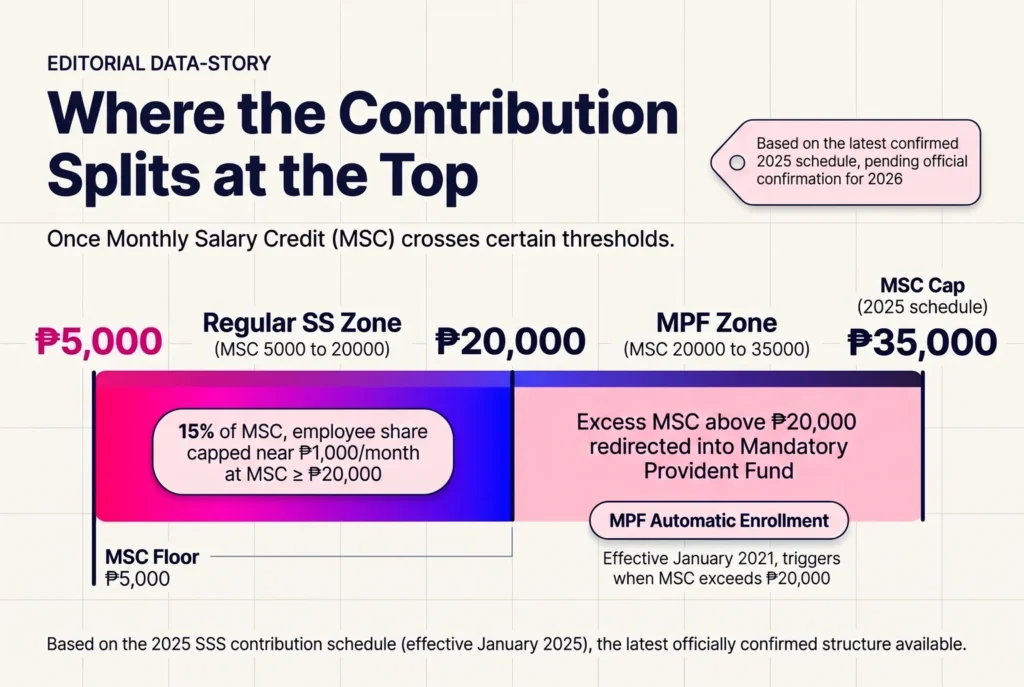
The last confirmed schedule, effective January 2025 under SSS Circular No. 2024-006, sets the total regular Social Security contribution at 15 percent of a member’s Monthly Salary Credit, split 10 percent employer and 5 percent employee. The MSC itself is a bracketed stand-in for actual salary, not the salary figure itself. Under the 2025 table, the MSC floor was raised to ₱5,000 and the ceiling to ₱35,000, replacing the previous ₱4,000 to ₱30,000 range, across 61 brackets that apply to employed, self-employed, and voluntary members alike, per the SSS contribution table.
Two things happen depending on where a member’s MSC falls. Below ₱20,000, the full 15 percent goes into the regular SS pool, funding the standard range of benefits: retirement, disability, death, sickness, maternity. Once MSC exceeds ₱20,000, a second layer kicks in automatically: the Mandatory Provident Fund, or MPF. This isn’t optional enrollment. Per SSS’s own guidance and Grant Thornton Philippines’ summary of Circular No. 2020-032, any member whose MSC crosses ₱20,000 is automatically enrolled in MPF, with the contribution calculated only on the portion of MSC above ₱20,000, up to the ₱35,000 cap. The regular SS employee share is capped at roughly ₱1,000 per month once MSC hits ₱20,000 or above, according to compliance summaries from TalinoHR; anything above that threshold gets redirected into the MPF tier rather than the base pension fund.
Practically, this means an employee earning at or near the ceiling isn’t paying more into the same bucket. Part of the contribution splits off into a separate provident fund account, which functions more like a savings component layered on top of the base pension.
What might happen in 2026 depends on the statutory design of Republic Act 11199, which mapped out scheduled rate increases culminating in the 15 percent rate reached in 2025. That was the final step in the legislated schedule. Whether MSC brackets shift again in 2026, whether floor and ceiling figures move further, or whether the rate itself changes, none of that has been confirmed in any circular SSS has published as of this writing. Some secondary sources have floated the idea that no further rate hike is due until 2027, but that claim has not been verified against an official SSS circular here, so treat it as unconfirmed, not settled. Any 2026 bracket table you see should be checked against the source before it goes anywhere near payroll.
Splitting the bill: employer and employee shares, worked through
Under the most recently confirmed schedule (2025), the 15 percent total contribution splits into a 10 percent employer share and a 5 percent employee share, a roughly two-to-one employer-to-employee ratio. The employee’s portion is deducted from pay; the employer’s portion is on top, funded by the company. On top of that, the employer alone pays a separate Employees’ Compensation contribution, either ₱10 or ₱30 depending on the MSC bracket, per DV Consulting’s summary of the schedule.
Here’s the sequence payroll staff would follow, using 2025 figures as the illustration:
Step one: find the employee’s actual gross monthly salary. Step two: match that salary to its bracket on the official SSS contribution table to get the Monthly Salary Credit, since the MSC is a standardized figure, not the raw salary. Step three: apply 10 percent of the MSC as the employer share, and 5 percent as the employee share. Step four: add the employer-only EC amount, ₱10 for MSC at ₱14,500 and below, ₱30 for MSC at ₱15,000 and above. Step five: sum employer share plus EC to get the total employer remittance, and use the employee share as the payslip deduction.
Take an employee whose gross salary lands them at an MSC of ₱20,000, illustrative only, and subject to revision once 2026 figures are confirmed. The employee share is 5 percent of ₱20,000, or ₱1,000. The employer share is 10 percent of ₱20,000, or ₱2,000. Since this MSC sits at or above ₱15,000, the EC add-on is ₱30, paid solely by the employer. Total employer remittance: ₱2,030. Total employee deduction: ₱1,000. Combined contribution remitted to SSS: ₱3,030.
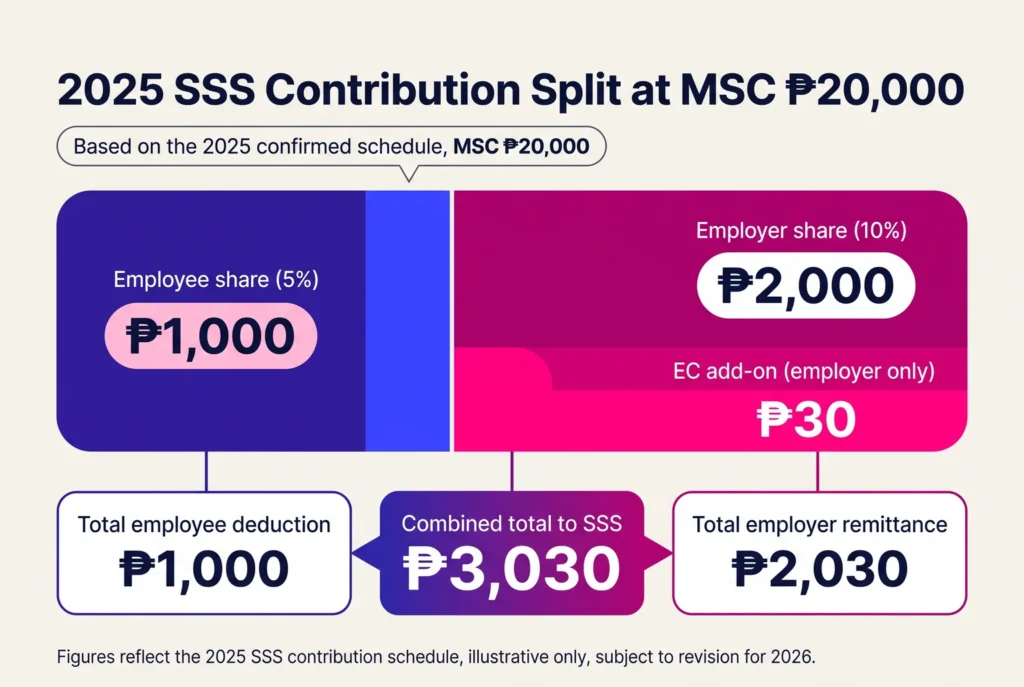
This example uses 2025 rates because that is the last officially confirmed structure. Whether the 10/5 split, the MSC brackets, or the EC amounts carry over unchanged into 2026 has not been confirmed in any published SSS circular as of this writing. The computation method itself, look up MSC, apply the percentage split, add employer-only EC, sum the totals, should carry over regardless of which numbers eventually apply. Payroll teams can plug in whatever figures SSS confirms for 2026 once available, using this same sequence.
When contributions are due, and what happens if they’re late
Deadline mechanics for SSS remittance are longstanding and unrelated to whatever rate figures apply in a given year, so this part of the system is unlikely to change for 2026. Still, always confirm actual dates against sss.gov.ph before finalizing a payroll calendar, since circulars occasionally adjust cutoffs for holidays or system maintenance.
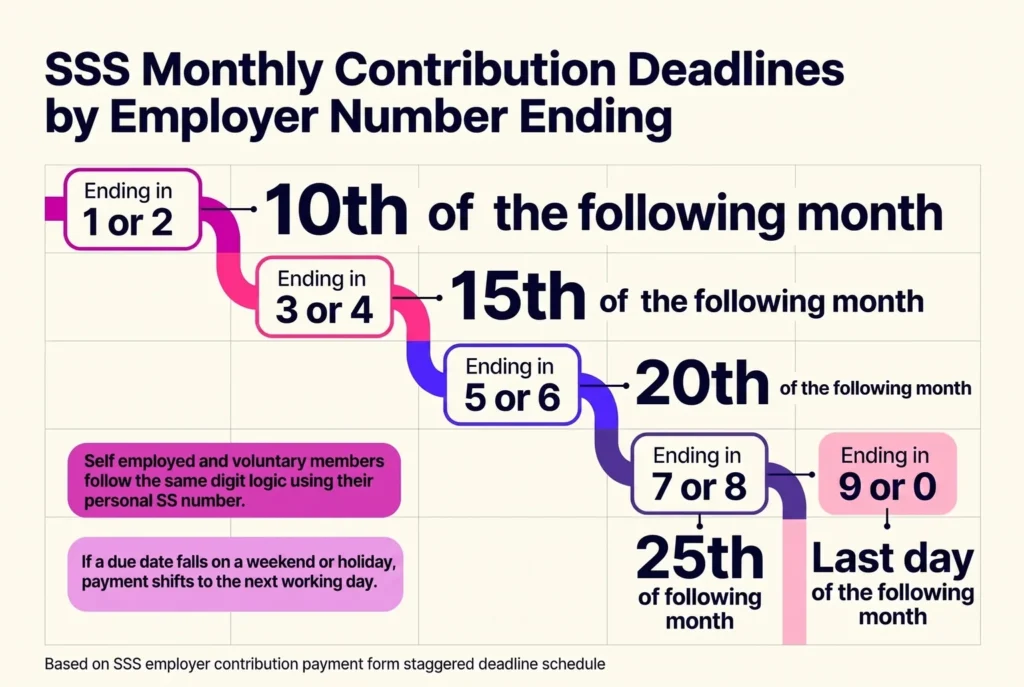
For business and household employers, the official employer contribution payment form staggers deadlines by the 10th digit of the employer’s 13-digit SSS number:
- Employer numbers ending in 1 or 2: due the 10th of the following month
- Ending in 3 or 4: due the 15th
- Ending in 5 or 6: due the 20th
- Ending in 7 or 8: due the 25th
- Ending in 9 or 0: due the last day of the following month
Self-employed and voluntary members follow the same digit-to-date logic, but tied to the last digit of their personal SS number, and they can remit monthly or by quarter. If a due date lands on a weekend or holiday, payment shifts to the next working day.
Missing the deadline triggers a statutory penalty, not a discretionary one. Under Republic Act No. 11199, late remittance carries a 2 percent per month penalty on the unpaid amount, computed from the original due date until the contribution is fully paid, as confirmed on SSS’s own penalty condonation notice. That’s compounding monthly exposure, not a one-time fine, so a contribution left unpaid for six months accrues roughly 12 percent in penalties on top of the principal owed.
For comparison, Pag-IBIG assesses penalties on a per-day basis, roughly a tenth of a percent daily, which works out to about 3 percent per month, according to a payroll compliance summary from TalinoHR. SSS’s rate is lower, but it applies to the full unpaid contribution, employer and employee shares combined, so the peso amount at stake is rarely small once several employees are involved.
Payroll teams should treat the ER-number stagger as the operational deadline, not the generic “last day of the following month” language sometimes quoted informally, since the form-based schedule is what SSS applies in practice.
Verifying the current table yourself, step by step
A large share of the search results for “SSS contribution table 2026” are third-party blogs, payroll aggregators, and social reposts. Some are accurate summaries of official circulars; others copy outdated figures or guess ahead of any confirmed release. Treat any table not hosted on sss.gov.ph, or not linked directly to a numbered SSS circular PDF, as unverified until cross-checked.
Start with the SSS website’s own contribution table page, which is meant to reflect the currently effective schedule. Cross-reference it against the circulars listing, where SSS posts the numbered documents (format CI-YYYY-XXX) that legally implement any rate change. If the contribution table page and the latest circular disagree, or if a circular hasn’t been issued for the year you’re computing, that’s the signal to hold off on updating payroll rather than trust a third-party recap.
For individual verification, employees and self-employed members can log into the My.SSS portal at member.sss.gov.ph using a registered User ID, password, and one-time PIN. Inside, Inquiry → Contributions shows a running summary of posted contributions, and members can pull month-by-month detail or download a printable statement, useful for reconciling what an employer actually remitted against what should have been deducted.

If a question can’t be resolved through the website or portal, SSS’s contact page lists the 1455 hotline and [email protected] for member concerns. Announcements about rate changes also go out through the verified @MYSSSPH accounts, though these should be treated as notice, not proof. Always trace the announcement back to the underlying circular before applying new figures to payroll.
The 2025 rate hike, and why 2026 is a different situation
RA 11199 (Social Security Act of 2018) set a fixed schedule of increases: 1 percentage point every two years until the total contribution rate hit 15% in 2025, split as 10% employer and 5% employee. That climb was mandated by law, not discretionary, and 2025 marks the end of the schedule. The statute does not call for further increases past 15%. Once that ceiling was reached, there was no built-in trigger for a 2026 hike.
That’s the confirmed part. Everything after it is where sourcing gets murkier.
Through early 2026, SSS itself moved on a different track: it rolled out a 10 percent pension increase for retirees while publicly stating there would be no contribution rate hike alongside it, according to reporting from ABS-CBN News. A separate Business Inquirer report cites SSS reiterating that member contributions would not increase through 2027. If accurate, that would mean the 15% rate carries forward unchanged, at least in the near term.
Treat both of those as news reporting on SSS statements, not as a substitute for a numbered circular. Reporting can misquote officials, compress nuance, or get overtaken by a later announcement. A statement made in February doesn’t bind SSS for the rest of the year, and policy bodies do reverse course.
Separately, a scatter of HR blogs and payroll aggregators have floated their own guesses about what 2026 might bring, some assuming a further increase, others assuming a freeze. None of these cite a circular. They’re speculation dressed up as forecasting, and none should be treated as authoritative.

The realistic read: the 15% rate very likely continues into 2026 based on statute and on SSS’s own public statements, but “very likely” is not the same as “confirmed by circular.” Until a numbered SSS circular says otherwise, hold that position loosely and verify before running payroll.
Reading your own SSS deduction line
The line item on your payslip is your half of the arrangement covered in the worked example earlier: your employer takes a share of your Monthly Salary Credit and matches it with a larger share of their own. Your payslip should show only your portion.
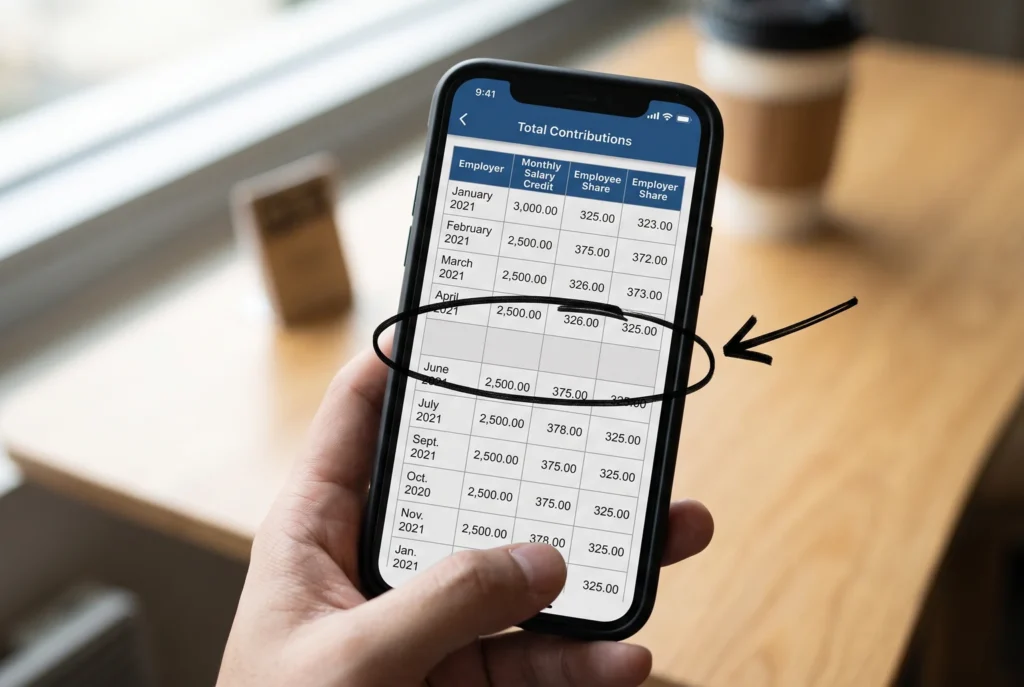
To confirm the amount is correct and actually reaching SSS, check it directly rather than trust the payslip alone. Log into the My.SSS portal or the MySSS mobile app using the same account credentials, go to Inquiry then Contributions, and you’ll see a month-by-month grid listing your employer’s name, your Monthly Salary Credit, and the amounts posted for each side. On the app, tapping Total Contribution shows the same breakdown. A blank month usually means nothing was posted for that period, which is worth following up on with your HR department.
One caution applies to employees too: whatever percentage your employer applies should reflect the current official SSS schedule, not a number from a blog post or a forwarded screenshot. If your deduction looks unusually high or low compared to your salary bracket, ask payroll which circular they’re using.
Before you run payroll, confirm the numbers
The single most important action for any employer or payroll team reading this guide is verification, not automation. Check the current schedule against the official SSS contribution table or a published SSS circular before applying any rate to a payroll run. Do this every cycle SSS announces a change, not just once a year.
Once the confirmed figures are in hand, the computation logic covered earlier (MSC bracket, employer and employee shares, MPF tier where applicable) stays the same. What changes is only the bracket and rate you plug in. Build that verification step into your payroll calendar the same way you track remittance deadlines.
This is also where the right systems help, without replacing the compliance judgment above. QWORK HRIS by Quadrant Alpha is built for Philippine payroll and HR processes, including timekeeping, payroll preparation, and configuration of statutory deductions like SSS, PhilHealth, and Pag-IBIG. It centralizes employee records and self-service requests so HR teams spend less time on manual tracking. It does not eliminate the need to confirm rates against SSS’s official releases each time a schedule changes, and no vendor tool should be treated as a substitute for that check.
For payroll teams weighing whether to keep manual spreadsheets or move to a configured platform, the practical takeaway is the same either way: verify first, then apply. If a more structured HR and payroll setup fits your team’s needs, Quadrant Alpha’s solutions page outlines what QWORK covers and how to get in touch for a walkthrough.